

UN Security Council reform vital to global peace, says COAS
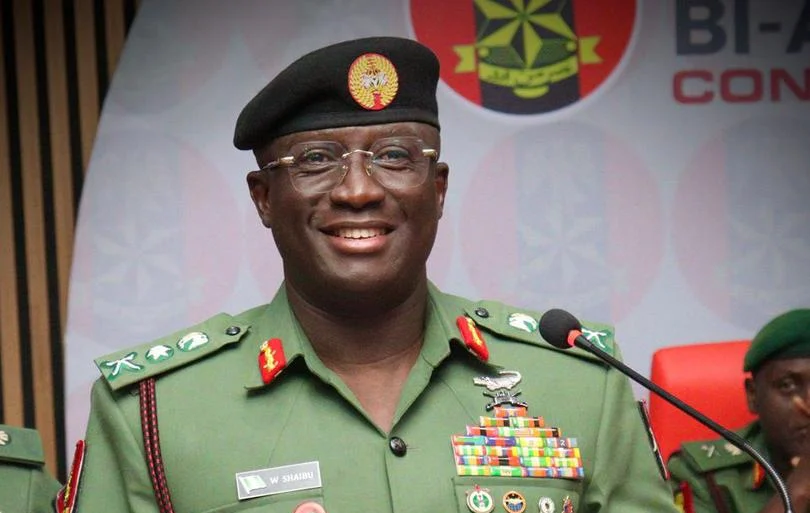
The Chief of Army Staff (COAS), Waidi Shaibu, has underscored the strategic importance of reforming the United Nations Security Council (UNSC), saying it remains critical to ensuring global peace.
Mr Shaibu said this on Thursday in Abuja at the public presentation of the book, “Nigeria’s Aspiration for a Permanent Seat in a Reformed United Nations Security Council”, authored by Abubakar Alkali.
Represented by the Provost Marshal (Army), Mathias Erebulu, he said it was also critical to ensuring security and equitable representation for Africa, including Nigeria.
He described the publication as an important scholarly contribution that addressed one of the defining governance questions of contemporary times.
This, he said, was the reform of the world’s foremost institution for maintaining international peace and security.
He congratulated the author for his intellectual courage and strategic foresight in producing a work that highlighted the need for reforms.
“It is through reforms that the world’s primary institution for the maintenance of international peace and security can remain legitimate and guarantee equitable and fair representation in the permanent seats to accommodate African states, including Nigeria,” he said.
Mr Shaibu noted that some might question the military’s interest in Nigeria’s quest for a permanent seat on the UN Security Council.
“The decisions taken by the global body directly shape the operational environment of armed forces across the world.
“It is the United Nations Security Council that authorises peacekeeping mandates, sanctions regimes and, where necessary, peace enforcement operations.
“It is also the council’s resolutions that shape the legal and political legitimacy under which multinational forces intervene to protect civilians, contain conflicts and support fragile transitions from war to peace,” he explained.
The army chief said the publication would deepen understanding of the nexus between global governance, international security and Nigeria’s foreign policy aspirations.
He added that the book would serve as valuable reference material for scholars and students of international relations while also broadening the geopolitical knowledge of military officers.
In his remarks, the author, Mr Alkali, said that the reform of the UN Security Council had become necessary and was no longer optional.
According to him, this is if the institution is to reflect contemporary global realities and effectively address questions of legitimacy, representation and equitable global governance.
He said that his engagements with diplomats and scholars, and his participation in UN seminars held in the United Kingdom and Greece during his doctoral studies, left a lasting impression that sharpened his thoughts in writing the book.
He noted that though the journey involved long nights of writing and moments of doubt, the clarity of purpose behind the work made every challenge worthwhile.
According to him, the publication deconstructs existing power relations within the UN Security Council by situating Nigeria and Africa’s quest for permanent membership within broader debates on representation.
“This includes membership composition and veto power politics that continue to shape perceptions of the council’s legitimacy,” he said.
He declined to divulge the detailed arguments contained in the publication, urging readers instead to obtain copies and engage critically with its contents.
Reviewing the book, Husseni Abdu said that the theoretical plurality represented one of the book’s major contributions, as it foregrounded the African perspective in contemporary debates on the UN Security Council reforms.
Mr Abdu explained that the book’s 10 chapters were logically organised, moving from theory and history to continental debates, national case studies and recommendations.
(NAN)

We have recently deactivated our website's comment provider in favour of other channels of distribution and commentary. We encourage you to join the conversation on our stories via our Facebook, Twitter and other social media pages.

More from Peoples Gazette

States
Independence: NBA urges Nigerians to expect better future
The NBA said that ordinary Nigerians should be deriving benefit from the subsidy removal rather than hardship.

Agriculture
FG tasks ECOWAS on leveraging financing strategies for agroecology
The federal government has urged stakeholders in the agriculture and finance sectors in the West Africa region to leverage financing strategies to enhance agroecology practices

Politics
Katsina youths pledge to deliver over 2 million votes to Atiku
“Katsina State is Atiku’s political base because it is his second home.”
Politics
2027: NDC to inaugurate presidential council October 20
The chairman said the party was taking time to make appropriate appointments to avoid disagreements that could disrupt its campaigns.

World
About one million without electricity after hurricane makes landfall in Florida
Isaias peaked as a category three hurricane, with heavy rain and powerful winds, but has since been downgraded.

Lagos
Lagos targets 3,000MW electricity supply by March 2027
Mr Sanwo-Olu said the initiative is part of efforts to end blackouts and build a 24-hour power economy in the state.
Politics
Nigeria at its best in 12 years; no govt has built infrastructure like my husband’s, says Remi Tinubu
Mrs Tinubu also cited the administration’s food support programme, saying it was designed to provide nutritious food for children.

States
Turkish Airlines increases Lagos flights from seven to 10 weekly
The statement added that the increase was aimed at meeting the growing travel demand between Nigeria and Türkiye.
States
Gov Yusuf condoles victims of bandit attack in Kano
Mr Yusuf assured residents that the state government was intensifying efforts to strengthen security through collaboration with relevant security agencies.


