

World’s 26 poorest countries in worst debt since 2006, World Bank says

The world’s 26 poorest economies—home to about 40 percent of all people who live on less than $2.15 a day—are deeper in debt than at any time since 2006 and increasingly vulnerable to natural disasters and other shocks, new analysis from the World Bank shows.
Yet international aid as a share of their GDP has dwindled to a two-decade low, forcing many to obtain financing on punishing terms.
The analysis constitutes the first systematic assessment of the causes of chronic fiscal weakness in the very poorest economies—those with annual per capita incomes of less than $1,145 a year. It finds that these economies are poorer today on average than they were on the eve of COVID-19, even though the rest of the world has largely recovered.
Government debt, on average, now stands at 72 percent of GDP, an 18-year high. Nearly half of these economies—twice the number in 2015—are either in debt distress or at high risk of it. Not one of them is at low risk.
Low-income economies’ ability to attract low-cost financing, meanwhile, has largely dried up: net official development assistance as a share of GDP fell to a 21-year low of 7 percent in 2022, the latest year for which data are available. That has left the World Bank’s International Development Association (IDA) as their single-largest source of low-cost financing from abroad.
IDA provides grants and near-zero-interest-rate loans to 77 of the world’s most vulnerable economies, and it is crucial to the 26 poorest among them: in 2022, IDA alone provided nearly half of all the development aid that these low-income economies received from multilateral organizations.
“At a time when much of the world simply backed away from the poorest countries, IDA has been their main lifeline,” said Indermit Gill, the World Bank Group’s Chief Economist and Senior Vice President for Development Economics. “Over the past five years, it has poured most of its financial resources into the 26 low-income economies, keeping them afloat through the historic setbacks they suffered. IDA has supported job creation and the education of children, worked to improve healthcare, and brought electricity and safe drinking water to large numbers of people. But if they are to rise out of a state of chronic emergency and meet key development goals, low-income economies will need to accelerate investment to a pace without precedent.”
The COVID-19 pandemic sharply increased spending needs in low-income economies, causing primary deficits to triple to 3.4 percent of GDP in 2020. Since then, low-income economies have been unable to fully unwind these deficits—which stood at 2.4 percent of GDP in 2023, nearly three times the average of other developing economies. Government spending has shifted away from crucial longer-term priorities, such as health and education, toward immediate needs: the wages of government workers, interest payments on debt, and subsidies.
The 26 low-income economies today enjoy significant potential to boost growth at home and contribute to broader prosperity and peace as well: their natural resources are ample, and their working-age populations are growing. Yet they also face a cluster of challenges that are more severe than anywhere else.
Two-thirds of them are either in conflict or have difficulty maintaining order because of institutional and social fragility. Nearly all are commodity-exporting countries, subject to repeated boom-and-bust cycles driven by the whims of commodity markets.
Those two elements alone intersect in ways that constitute a trap of sorts for low-income economies. Wars do lasting harm to government budgets: on average, fiscal balances worsen by up to 1.5 percentage points of GDP.
Commodity-price slumps associated with global recessions, meanwhile, tend to increase the poorest countries’ debt by as much as two percentage points of GDP. The effect of such shocks on government budgets tends to last for at least two years.
Between 2011-2023, natural disasters were associated with average annual losses of 2 percent of GDP—five times the average losses in lower-middle-income countries. The costs of adapting to climate change are also higher for low-income economies than for other developing economies—the equivalent of 3.5 percent of GDP per year, five times the rate for lower-middle-income countries. These constraints mean that low-income economies will need to ramp up investment at a history-making pace and deliver dramatically higher performance on every level of economic management if they are to meet development goals by 2030, the analysis indicates.
“There is much that low-income economies can—and must—do for themselves,” said Ayhan Kose, the World Bank’s Deputy Chief Economist and Director of the Prospects Group. “They can broaden their tax base by simplifying taxpayer registration and tax collection and administration. They also have plenty of room to improve the efficiency of public spending. But these economies also need stronger help from abroad—both in the form of greater international cooperation on trade and investment and in the form of much larger support for IDA, which can work with the private sector to mobilize additional resources and help facilitate structural reforms. IDA, in short, is a vital development partner for these countries—because of its successful track record of delivery, its affordable financing options, its deep expertise in development, and its sound policy advice.”

We have recently deactivated our website's comment provider in favour of other channels of distribution and commentary. We encourage you to join the conversation on our stories via our Facebook, Twitter and other social media pages.

More from Peoples Gazette

States
Independence: NBA urges Nigerians to expect better future
The NBA said that ordinary Nigerians should be deriving benefit from the subsidy removal rather than hardship.

Agriculture
FG tasks ECOWAS on leveraging financing strategies for agroecology
The federal government has urged stakeholders in the agriculture and finance sectors in the West Africa region to leverage financing strategies to enhance agroecology practices

Politics
Katsina youths pledge to deliver over 2 million votes to Atiku
“Katsina State is Atiku’s political base because it is his second home.”
Anti-Corruption
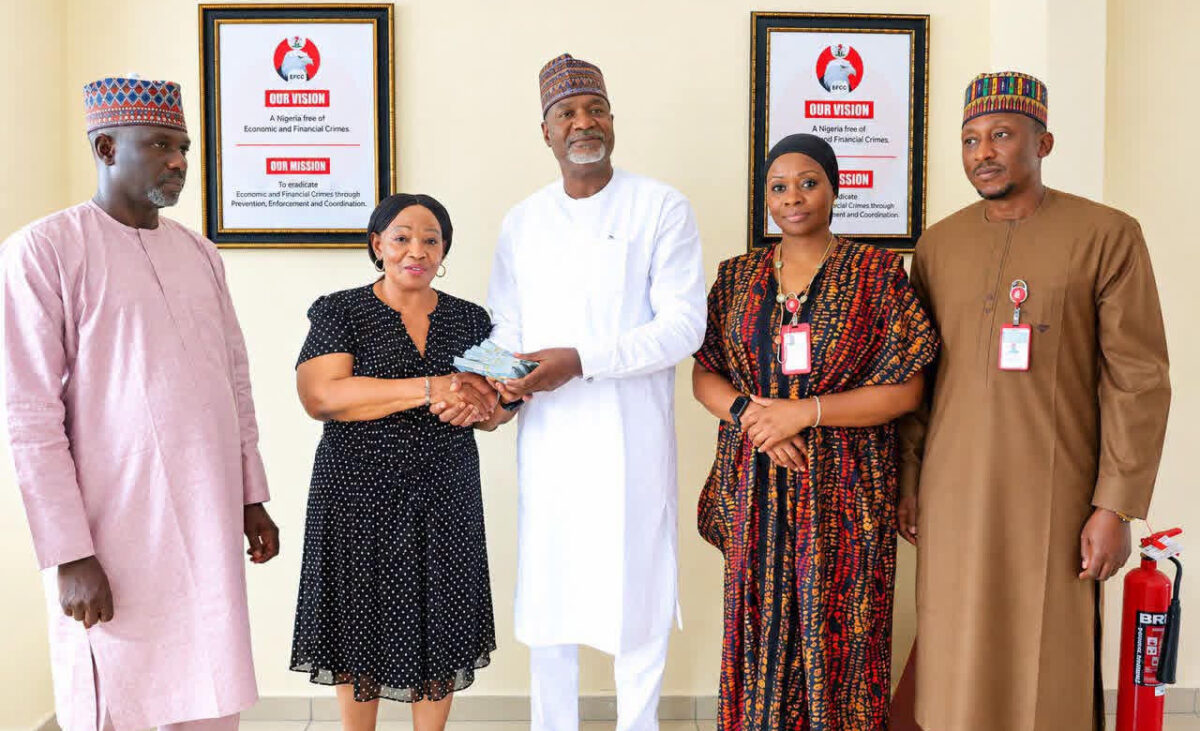
EFCC recovers $104,950 for U.S.-based businesswoman Adeshola Oshilaja defrauded by family friend
Ms Oshilaja commended the commission for its efforts and professionalism in handling the case.

Heading 5
OAU researcher secures $5 million grant to reduce maternal deaths in Nigeria
The statement noted that Mr Awowole’s work on PRIME targets reducing maternal deaths in Nigeria by 60% with Nigeria accounting for a quarter of global maternal deaths.

Abuja
Dutse residents commend road rehabilitation, seek quick completion
Mr Ishaku earlier promised that his administration would ensure the completion of ongoing projects.

States
Gov. Okpebholo receives late Orbih’s remains at Benin Airport
Mr Ize-Iyamu said Mr Orbih was a generous and compassionate man who helped countless people.
NationWide
Stock market rebounds, adds N209 billion to investors’ wealth
Red Star Express led the gainers, appreciating by 9.76 per cent to close at N13.40 per share.
States
Chairman vows to end ritual killings in Plateau LG
Mr Gonung also called for stronger collaboration among security agencies.


