

Electricity crisis and the rest of us
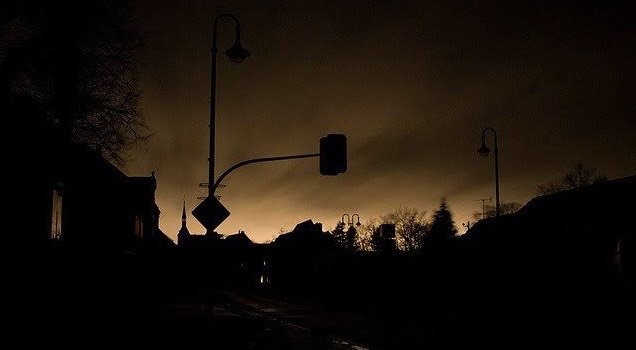
There is a peculiar cruelty in darkness when it is not the darkness of night. Not the gentle, expected dimming of the sun that invites rest, reflection, or even romance, but a stubborn, imposed darkness that lingers long after dawn has broken and refuses to yield even to the harsh insistence of the afternoon heat; and it is this cruelty that has settled over our homes and lives with a suffocating permanence these past days, such that one begins to wonder whether light itself has become a rumour in the Nigerian imagination rather than a public utility guaranteed by the simple dignity of citizenship.
The bulbs in my home have not blinked for five straight days, nor have they come on and off in that familiar, irritating fashion that Nigerians, with their unrivalled genius for euphemism, describe as flashing; and in that absence of even the most unreliable flicker, one is forced into a deeper recognition that what we once complained about as inconsistency was in fact a luxury compared to the present condition of total and unbroken darkness, a darkness so complete that even hope begins to feel like an indulgence rather than a necessity.
In effect, my home has been in darkness for five days, and in that darkness the ordinary cadences of life have been suspended, distorted, and in some cases entirely erased, because electricity in our time is not merely a convenience but the invisible scaffolding upon which modern existence precariously rests, and when it disappears, it takes with it not just light but the fragile order that holds together our domestic, economic, and emotional lives. Forget the fridges and freezers, for they have not experienced electricity long enough to live up to their essential nature of preserving the perishables that sustain us, and what was once stored in quiet assurance now decays in silent protest, mocking both our expectations and the promises of those who claim to govern in our interest, while the kitchen itself becomes the theatre of loss where the slow spoilage of food mirrors the steady erosion of public trust.
You ask about the generator, and I will answer you in the Nigerian way by asking you a question, because questions have become our last refuge when answers are either unavailable or deliberately withheld, and so I ask: Is the cost of a litre of petrol in your area not enough to keep your generator silent? This is not because the machine has failed in its mechanical duty, but because the harsh arithmetic of survival has turned its use into an act of financial folly, one that only the most desperate or the most heedless of consequence would dare to indulge.
There you have the answer. So, what then are we left with, if not the absurdity of a nation rich in energy resources but perpetually starved of energy supply; a paradox so entrenched that it has ceased to shock and has instead become the background condition of our existence, like humidity in the air or dust on the roadside, something to be endured rather than interrogated, even though its origins lie not in fate but in the accumulated failures of policy, planning, and accountability.
Nobody is explaining why Nigerians are living in darkness and in the oppressive heat of what feels like the worst dry season in many years, and this silence from those entrusted with power is perhaps more disturbing than the blackout itself, because it suggests not merely an absence of solutions but an absence of curiosity, a lack of urgency that borders on indifference, as though the suffering of millions were a minor inconvenience rather than a national emergency demanding immediate and transparent response.
The Minister of Power has apologised for the massive power failure across the country, and while apologies in public life are not in themselves objectionable, one is compelled to ask what exactly is being apologised for, because an apology without explanation is little more than a ritual gesture designed to pacify rather than to inform, and in the absence of clarity it becomes impossible to distinguish between genuine contrition and pretend governance.
By the way, how can anyone apologise for incompetence if not madness, for incompetence is not an isolated incident but a pattern, a recurring failure that reveals itself over time through repeated breakdowns, un-met targets, and the persistent inability to deliver on the most basic obligations of office, and to apologise for it without addressing the root causes is to mistake the symptom for the disease, or worse, to pretend that the disease does not exist at all.
It is here that survival itself requires a keen eye and sharp tongue, because the reality we inhabit often defies straightforward description, demanding exaggeration and irony to reveal its deeper absurdities, and one is tempted to imagine what Fela Anikulapo Kuti would have made of this moment, for he, with his unflinching gaze and fearless voice, might have described those governing a nation in darkness with words that polite society would hesitate to repeat, calling them crase people fit only for the asylum, not out of mere insult but as a diagnosis of a country that long lost its capacity for rational function.
But, there is something more troubling about us, about how we have come to accommodate this abnormality as though it were inevitable, how we have adjusted our lives around generators, inverters, candles, rechargeable lamps, about how we profer private solutions to what is fundamentally a public problem; and in doing so, perhaps, unintentionally relieving those in authority of the pressure to provide collective answers. For the electricity crisis is not merely the failure of generation, transmission, or distribution, although it is all of these in abundance, but also a political failure, and a failure of imagination and responsibility in which the state has retreated from its role as provider of essential services and citizens have been left to negotiate their own survival within an environment of chronic uncertainty. Does it surprise you that Aso Rock, the seat of power, has gone off-grid? Tinubu is virtually telling you, ON YOUR OWN, OYO!
The tragedy is compounded by the fact that darkness is not evenly distributed, for there are enclaves where power flows with relative stability, often insulated by privilege, proximity to power, while vast stretches of the country remain trapped in cycles of outage that undermine productivity, education, healthcare, and the simple dignity of daily living, thereby deepening existing inequalities and reinforcing the sense that citizenship itself is stratified.
And so we return to the opening image of a home in darkness, not as an isolated anecdote but as a microcosm of a national condition, a reminder that behind the statistics about megawatts and grid capacity lies the lived experiences of individuals and families whose lives are constrained by the absence of something as basic as light, whose aspirations are dimmed not by lack of ambition but by the failure of systems that ought to enable them.
The electricity crisis forces us to confront uncomfortable truths about governance, accountability, and our own thresholds for endurance, and it challenges us to decide whether we will continue to adapt indefinitely to dysfunction or whether we will demand, with clarity and persistence, a different standard of public service, one in which apologies are accompanied by explanations, explanations by action, and action by measurable improvement. For now, we remain, quite literally and metaphorically, in the dark, living in a country where light is intermittent, explanations are scarce, and irony often feels like the most honest language available to describe a reality that should, by any reasonable measure, be unacceptable.
Did I hear you say: “Let there be light”?
Abdul Mahmud, a human rights attorney in Abuja, writes weekly for The Gazette

We have recently deactivated our website's comment provider in favour of other channels of distribution and commentary. We encourage you to join the conversation on our stories via our Facebook, Twitter and other social media pages.

More from Peoples Gazette

States
Independence: NBA urges Nigerians to expect better future
The NBA said that ordinary Nigerians should be deriving benefit from the subsidy removal rather than hardship.

Agriculture
FG tasks ECOWAS on leveraging financing strategies for agroecology
The federal government has urged stakeholders in the agriculture and finance sectors in the West Africa region to leverage financing strategies to enhance agroecology practices

Politics
Katsina youths pledge to deliver over 2 million votes to Atiku
“Katsina State is Atiku’s political base because it is his second home.”
World
UK court sentences Irish lawmaker Jeffrey Donaldson to 15 years in prison for raping children
One of the women described the rape as “the worst moment of her life”.
Africa
Kenya announces second Ebola case, downplays wider spread
The ministry said the victim had been in contact with 128 people.
States
Bauchi govt restates commitment to girls education
The commissioner enjoined parents to support their children, especially girls, to complete their education.

Heading 4
Presidency to send State Police Bill to National Assembly in two weeks
He described the proposed legislation as the most consequential bill of Mr Tinubu’s administration.
States
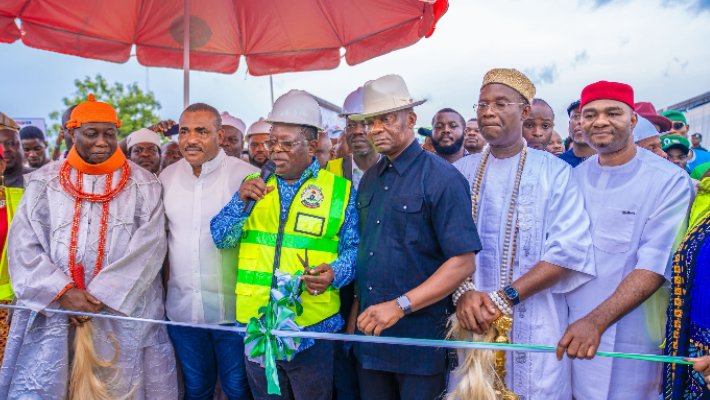
FG reopens First Niger Bridge after 38 days
Mr Umahi said the intervention reflected President Bola Tinubu’s commitment to maintaining critical infrastructure.

Health
Group urges lawmakers to strengthen oversight on nutrition funding
The programme manager said accountability in nutrition financing has been lacking over the years.


