

Adebayo Adelabu’s vanity mansion and eternal life lessons
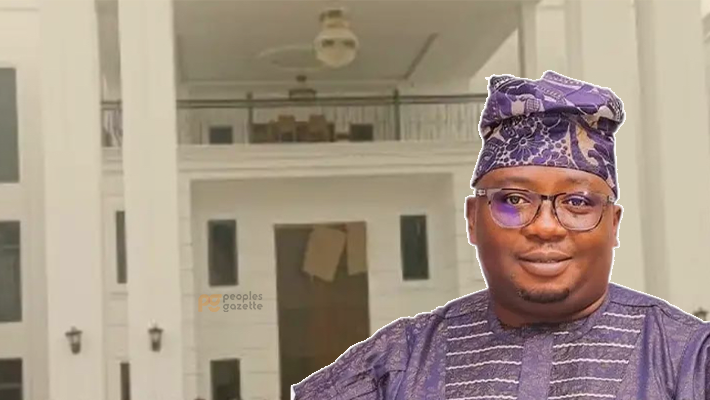
A few days ago, a video of power minister Adebayo Adelabu, taking an inspection tour of his new Ibadan mansion, went viral. It was a stately building, with its white walls gleaming under the sun. Netizens quickly dubbed it “The White House”,; a deliberate comparison meant to sting. The image of the stately mansion is only comparable to the grand residences of the late banker, Herbert Wigwe and the mansion of former governor Adams Oshiomhole in Iyamho, which went viral not long ago. In each case, the architecture spoke loudly of wealth and status. But the public reaction to the minister’s mansion was not admiration. It was anger. The outrage focused on the irony.
Here was a minister who presides over the darkness that has become the daily reality of millions of Nigerians, proudly showing off a palace powered by private generators. At the same time, ordinary citizens sit in homes without light. Many online commentators described Adelabu’s opulent display as an example of “wealth without production”, a phrase that captures the deep resentment citizens feel towards public officials who live in abundance while the country’s infrastructure collapses. It struck a nerve because it fits into a long-standing pattern: in our country, political office too often becomes a direct route to personal opulence.
Mansions rise not as the fruits of decades of private enterprise but as monuments to the unspoken belief that public service is an avenue for self-enrichment. The speed with which such houses are built, often within a single tenure, contrasts sharply with the decades-long neglect of public housing, hospitals, and power infrastructure. The message is clear: the office holder’s comfort comes first; the citizens’ needs are an afterthought.
The Russian writer, Leo Tolstoy, captured the folly of this mindset in his short story, How Much Land Does a Man Need? It tells of a peasant who was promised all the land he could walk around in a single day. Driven by greed, he walked further and further, trying to enclose more land than he could manage. By sunset, he collapsed and died. The land he truly needed was only six feet long, enough to bury him. A sage might pose the same question differently: How many rooms does a man require in death? The answer is the same: one. This truth is as old as human civilisation; yet, it is one humanity continually ignores. Life ends in a modest chamber: a hole in the earth, no deeper than six feet. It has no marble floors, no chandeliers, no carved doors. Dust becomes its only furniture. Still, generation after generation, some citizens build as if stone and steel can outwit mortality. They labour and scheme to raise monuments to themselves, ignoring the certainty that time will one day strip them bare.
History offers countless reminders.
Mobutu Sese Seko, the long-time ruler of Zaire, built a palace in Gbadolite that defied imagination. It had gold-plated doors, imported marble, and swimming pools that shimmered in the tropical sun. It was called the “Versailles of the Jungle”. Today, it is in ruins. The forest has reclaimed it. Trees pierce its roof. Birds sing in its grand halls. The rustle of leaves has long replaced human laughter. Time has mocked the ambition that raised it. The same fate awaits every mansion, no matter how well built. A day will come when the Minister’s “White House” will be silent. The paint will peel. The roof will sag. Grass will grow in the driveway. The owner will no longer walk its corridors. It may pass to heirs, be sold, or fall into disrepair. But the owner’s final dwelling will not be a mansion. It will be that one unadorned room in the ground.
Why, then, do some live as though the sizes of their houses measure the worth of their life? Part of the answer lies in our culture, where wealth is often performed rather than quietly lived. Houses are no longer just shelters; they are trophies, built to be admired and envied. The sheer scale of a house becomes a public statement: I have arrived. This is why many politicians race to complete grand residences before leaving office, and why, amid widespread poverty, we see houses with more bathrooms than occupants. This impulse is not unique to our country. Throughout history, rulers and elites have built palaces on the backs of the poor.
In France, Louis XIV built Versailles while his people endured heavy taxation and bread shortages. In Uganda, Idi Amin occupied a lavish palace while the country’s hospitals collapsed. In Libya, Muammar Gaddafi’s Bab al-Azizia compound was a sprawling fortress of luxury in the middle of national decay. In each case, the palace stood as a symbol of distance between ruler and ruled. In each case, history eventually reclaimed the house, if not in ruins, then in repurposing it. Recall how Amin’s palace became a military barracks, and Gaddafi’s fortress was bombed into rubble.
The death of Herbert Wigwe last year underscored the fleeting nature of such displays. Many mourned the man, but images of his sprawling estate circulating online carried a silent reminder: death is the great leveller. It empties bank accounts. It silences the hum of air conditioners. It renders both the pauper’s shack and the tycoon’s mansion equally irrelevant. The same earth that receives the poor will receive the rich. No vault can buy exemption.
Those in power often imagine that the grandeur of their houses will secure their legacy. But history shows that wind and rain are tireless erasers. The Pharaohs of Egypt built pyramids to preserve their names. The pyramids still stand, but most of their builders’ names are forgotten. Tourists walk through their tombs, marvelling at treasures buried with men who once thought themselves eternal. Today, in our country, modesty in public life is rare and often misunderstood. A leader who builds no mansion is seen as lacking ambition. A public servant who retires to a simple home is treated as an oddity. Our rulers have inverted the measure of worth: it is no longer the quality of one’s service, but the size of one’s estate that counts.
This is why the outrage over the minister’s mansion matters. It is not just about one house; it is about the values it represents. There is also the moral question of timing. A nation in darkness does not want to see its Minister of Power unveiling a mansion. A country with poor roads does not want to see its Minister of Works importing marble for private staircases. It sends the wrong message. It deepens the trust deficit between the government and the governed. It makes people believe, not without reason, that those in office are there first for themselves.
Perhaps the minister sees the public anger as a passing storm. He may believe that ordinary citizens will move on, distracted by the next crisis. And perhaps they will. Our citizens have short political memories. But the question Tolstoy posed, and the answer it demands, will not fade. How many rooms does a man require in death? One.
The lesson is not an argument against comfort or even against building houses. It is a reminder that our buildings are not the measure of our lives. They will not follow us beyond the grave. What will endure is the impact we have on the lives of others. A society that forgets this will keep producing leaders who see office as a ticket to self-display rather than public service. There is a proverb from my Etsako provenance that says, “After the market closes, it is home we return to”. You may spend all day at the market, but eventually you must return home. Death is that return. You cannot take your purchases with you. The stall is left for others. That truth should guide those who hold public office.
The most enduring “White House” is not one with gleaming marble floors and imported chandeliers, but one where the citizens under your care can live in dignity. If our country must move forward, the rulers and the ruled need a cultural shift. They must prize integrity over opulence, service over self-display, and function over spectacle. Rulers should be remembered for the schools they built, the roads they repaired, the hospitals they equipped, the lives they improved, not for the sizes of their living rooms or the gloss on the marble floors. But, if they persist, nature, as always, will be on hand to reclaim the products of their follies while the true work of nation-building remains undone.
One day, every mansion will fall silent. The forest may not reclaim them as it did Mobutu’s palace, but time will. Dust will settle where laughter once lived. And when it does, the question will remain, as urgent and unanswerable in brick as it is in earth: How many rooms does a man require in death?
Just one, I hear you say.
Abdul Mahmud is a human rights attorney in Abuja

We have recently deactivated our website's comment provider in favour of other channels of distribution and commentary. We encourage you to join the conversation on our stories via our Facebook, Twitter and other social media pages.

More from Peoples Gazette

States
Independence: NBA urges Nigerians to expect better future
The NBA said that ordinary Nigerians should be deriving benefit from the subsidy removal rather than hardship.

Agriculture
FG tasks ECOWAS on leveraging financing strategies for agroecology
The federal government has urged stakeholders in the agriculture and finance sectors in the West Africa region to leverage financing strategies to enhance agroecology practices

Politics
Katsina youths pledge to deliver over 2 million votes to Atiku
“Katsina State is Atiku’s political base because it is his second home.”
Heading 3
APC will give those who don’t see good things happening in Nigeria Tinubu glasses to see clearly: Remi Tinubu
Mrs Tinubu prayed that she plans to leave the Aso Rock in 2031.

Africa
Nigeria hosts African counter-terrorism forum in Abuja Monday
Mr Adamu said the proposed forum would review progress under the Abuja Process.

Diaspora
U.S. declares two Nigerians Ezechukwu, Olukoya wanted over conspiracy, $3.1 million medicare fraud
The health department said Mr Ohaka falsely referred to himself as Dr. Joshua Ohaka.

Uncategorized
Bundibugyo Ebola in DRC, Kenya, Nigeria requires strengthened regional surveillance: WHO
The WHO said transmission remained high in the DRC.

Heading 1
Trump administration deported 980,000 migrants in 18 months: Report
The report stated that across all 980,000 deportations carried out by ICE or CBP, 20 per cent (190,000) involved a non-citizen convicted of a crime.

NationWide
Nigeria’s Ebola case genetically similar to Kenya index case, says Pate
The minister said the finding could influence the understanding of the virus’ transmission route.


