

After correcting the map, can Africa correct the balance of global power?
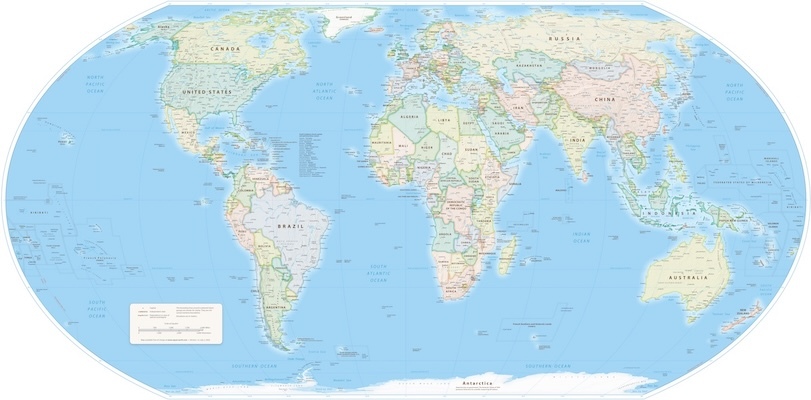
The first known map to render part of what is now Africa was drawn under Roman rule by the Alexandria-based astronomer and geographer Claudius Ptolemy, whose Geographia sketched the continent’s northern and eastern edges roughly seventeen centuries ago. The oldest near-complete representation of the continent, The Great Ming Amalgamated Map, dates from the 14th Century. Even then, the map served an empire’s purposes rather than Africa’s own: it recorded what Rome needed to know about trade routes and its frontiers (and in the Chinese case, a representation of its impressions of a far flung landmass), not what the continent needed the world to understand about itself.
Maps have rarely been neutral. As United States President Donald Trump’s recent renaming of the Gulf of Mexico and Lake Ontario shows, maps have often been expressions of ambition dressed as instruments of measurement. Nowhere was that clearer than at the Berlin Conference of 1884-85, where European powers carved up a continent they had barely surveyed. The Scramble for Africa ran on cartography that was itself wrong, with straight borders drawn across unmapped terrain by men settling their own rivalries, with the people living inside those lines an afterthought. The map did not describe the partition. It enabled it.
That history is worth holding in mind now that the United Nations has voted, 164 to one with six abstentions, to endorse a campaign against the very kind of distortion that made 1884 possible. The resolution, sponsored by Togo on the African Union’s behalf, promotes the Equal Earth projection over the 16th-century Mercator map, which shrinks Africa on paper to roughly the visual size of Greenland, even though Africa is about 14 times larger by land area. Togo’s foreign minister, Robert Dussey, called the vote an act of “cognitive justice.” The U.S. cast the lone dissenting vote, dismissing the resolution as an “ideological agenda.”
It is tempting to read this as a hinge moment, the point at which Africa began converting its numbers into influence. I think the opposite is the case, and I want to illustrate the point by comparing Africa’s route to global prominence with the routes taken by two regions that never needed a map-justice campaign.
East Asia did not correct a map to become an economic power. It built factories, then negotiated from the leverage those factories produced. Japan, South Korea, Taiwan and China rose within a Cold War paradigm in which the U.S. had a direct strategic interest in their success as bulwarks against communism, extending capital, market access and tolerance for industrial policy that it withheld elsewhere. Recognition followed capability. In other words, nobody voted South Korea into relevance. Its shipyards, car factories and semiconductor plants did that.
On the other side of the Pacific, Latin America never ran a comparable campaign either, for a simpler reason: it did not need one. Most of the region had been independent and seated at international tables for more than a century by the time the UN Charter was signed in 1945, while Africa had only four of the 51 founding members: Egypt, Ethiopia, Liberia and South Africa. The architecture of the postwar order, including permanent Security Council seats and the IMF voting shares, was substantially fixed before most African states existed as sovereign actors. That is a genuine, structural difference, and it is perhaps the strongest defence of why Africa’s case looks different on paper.
It does not, on its own, explain why Africa’s response has taken the form it has. The uncomfortable possibility Nigerian and African policymakers should reckon with is that symbolic correction may be what the international system offers precisely because it costs nothing.
No credit rating moved on September 4. No Security Council seat changed hands. No capital flow was redirected. The United States could afford to cast the sole “no” vote and absorb whatever reputational cost came with it, because the resolution asked it to give up nothing. Compare that with two decades of complete paralysis over the Ezulwini Consensus, Africa’s demand for two permanent Security Council seats, a proposal that has remained unimplemented for more than 20 years.
Seen this way, the 164-vote majority is not necessarily evidence that Africa’s diplomatic clout is growing. It demonstrates how relatively cheap recognition can be and how expensive power remains.
East Asia’s history suggests the sequence runs first from capability to recognition. If that sequence holds, the danger facing African governments is not that they will fail to convert the map into leverage. It is that the map will feel adequate, an emotionally satisfying correction that lets a continent feel something has shifted while the instruments that actually allocate power and determine sovereign borrowing costs, the terms on which African commodities and labour enter global markets, stay exactly where they were.
The same coalition that produced 164 votes on a symbol is capable of coordinating on substance. The African Continental Free Trade Area, if fully implemented, gives the continent a market of more than a billion consumers with which to bargain as a bloc rather than as 54 fragments. The Ezulwini Consensus has never lacked clarity, only leverage. And African institutions, rather than foreign advocacy campaigns, will have to lead efforts to change how global credit markets assess African risk, since no outside actor has the same incentive to do that work for us.
The Scramble for Africa drew borders on bad maps. Correcting the map does not undo that history. It only removes one excuse for repeating it.
Whether the UN resolution is remembered as the beginning of something truly game-changing or as its own kind of Berlin Conference, a moment when the world felt it had settled Africa’s status without changing anything that mattered, depends on what African governments do next, not on what the United Nations just voted for.
- Ikemesit Effiong is a lawyer, geopolitical analyst and Managing Partner at SBM Intelligence. He writes from Lagos.

We have recently deactivated our website's comment provider in favour of other channels of distribution and commentary. We encourage you to join the conversation on our stories via our Facebook, Twitter and other social media pages.

More from Peoples Gazette

States
Independence: NBA urges Nigerians to expect better future
The NBA said that ordinary Nigerians should be deriving benefit from the subsidy removal rather than hardship.

Agriculture
FG tasks ECOWAS on leveraging financing strategies for agroecology
The federal government has urged stakeholders in the agriculture and finance sectors in the West Africa region to leverage financing strategies to enhance agroecology practices

Politics
Katsina youths pledge to deliver over 2 million votes to Atiku
“Katsina State is Atiku’s political base because it is his second home.”

World
BST: UK time changes on Sunday
The clock will be changed again on the last Sunday in March 2027.

States
Police nab man over alleged murder of ex-girlfriend in Anambra
The police said the arrest of the suspect followed a report by the victim’s mother to the Divisional Police Officer (DPO), Umuchu Division.
NationWide
North will return Tinubu to Aso rock in 2027, says Kwankwaso
Mr Kwankwaso dismissed any suggestion that the North’s support for Mr Tinubu was transactional.
Faith
Asari Dokubo visits Ooni, invites monarch to his December coronation in Rivers
The monarch appreciated Mr Dokubo for the visit.

Hot news Home top
Tinubu’s panic ahead of 2027 can’t erase APC terrible record: ADC
The council said, “Bola made life expensive; Atiku will make Nigeria affordable again!”

World
Turkey cautions against renewed attack on Iran, seeks dialogue
Mr Fidan said, “We are all in agreement that a new attack on Iran would expand the war in the region.


