

Australians’ favourite foods generating highest greenhouse gas emissions: Report

Australians’ love for red meat, chocolate, and coffee came at a high environmental cost, as they were often the products that generated the highest rates of greenhouse gas emissions.
The highest country’s packaged food supply said in a report on Wednesday.
The report published by the George Institute for Global Health said the study assessed over 25,000 food and beverage products from major Australian retailers.
They found these popular grocery staples among the biggest contributors to greenhouse gas emissions.
Using the newly developed Planetary Health Rating system, the study gave Australia’s overall packaged food supply an average of 2.5 out of five stars for environmental impact.
The report said red meat scored the lowest at 0.7 stars, followed by chocolate at 1.4 stars and coffee at 1.6.
It added that, in contrast, fresh fruits and vegetables, along with dairy-free yoghurts, rated highest at 3.6 stars, topped only by plain bottled water with five stars.
Simone Pettigrew at the University of New South Wales, also head of health promotion at the George Institute for Global Health, said food production accounts for around one-third of global emissions.
Although the shoppers have almost no way of knowing a product’s climate impact, the report suggested that Australians could cut more than 6,000 kg of emissions per year, equivalent to three round trips between Perth and Sydney.
This is done by replacing red meat and dairy with plant-based or lower-impact alternatives like poultry, seafood, and plant-based milk, Ms Pettigrew said.
She said highly processed foods also generate more emissions, making whole fruits and vegetables a better choice for the environment and personal health.
She added that the purpose-built ecoSwitch smartphone app equipped shoppers to make more sustainable grocery choices.
(Xinhua/NAN)

We have recently deactivated our website's comment provider in favour of other channels of distribution and commentary. We encourage you to join the conversation on our stories via our Facebook, Twitter and other social media pages.

More from Peoples Gazette

States
Independence: NBA urges Nigerians to expect better future
The NBA said that ordinary Nigerians should be deriving benefit from the subsidy removal rather than hardship.

Agriculture
FG tasks ECOWAS on leveraging financing strategies for agroecology
The federal government has urged stakeholders in the agriculture and finance sectors in the West Africa region to leverage financing strategies to enhance agroecology practices

Politics
Katsina youths pledge to deliver over 2 million votes to Atiku
“Katsina State is Atiku’s political base because it is his second home.”

NationWide
Nigerian Army prioritises personnel training to combat insecurity: Shaibu
The Nigerian Army has restated its commitment to deploying effective military arsenals and training personnel to combat terrorism and emerging security threats in the country.

Abuja
Diana London, American right-wing lobbyist who interviewed Tinubu at Aso Rock, was paid $4.5 million by Nuhu Ribadu: Documents
Adorned in a $10,000 Black Schiapparelli skirt suit, Ms London posed with Mr Tinubu in pictures posted on social media, describing Nigeria as the “America of Africa”.
Abuja
NBC reaffirms commitment to addressing transboundary challenges
NBC reaffirmed its commitment to addressing transboundary challenges and strengthening cooperation with Nigeria’s neighbouring countries.

Education
Gov Ododo orders investigation into death of Kogi nursing student
Governor Ahmed Ododo ordered an investigation into the circumstances surrounding the death of Adewumi Gift, a student of the Kogi State College of Nursing Sciences.

Sport
2027 AFCON Qualifier: Guinea-Bissau beat Madagascar, extend lead over Nigeria in Group L
Guinea-Bissau now have 10 points, Nigeria seven points, while Madagascar and Tanzania have two points each.
Africa
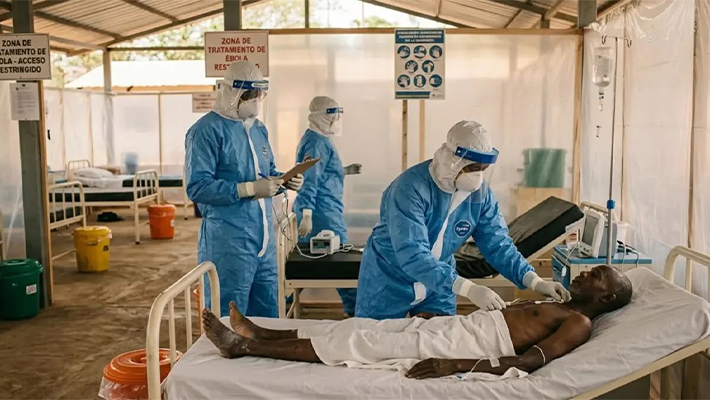
WHO raises concern over rising Bundibugyo Ebola deaths, insecurity in DR Congo
Mr Ghebreyesus said the outbreak, declared six months ago, had spread across 67 health zones in eight provinces in the DR Congo.


