

Understanding the flight announcer
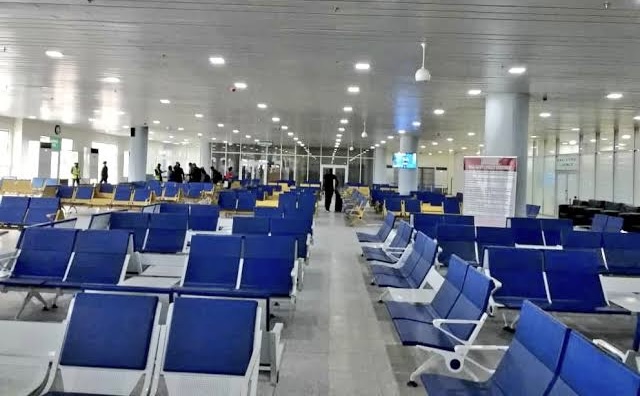
Boarding announcements were not an issue when I used to commute in Lagos by danfo, the ubiquitous yellow buses, or molue, the mass-transit lorries, which were improvised for public transportation.
The conductors often had a melodious and entertaining way of calling passengers that was enjoyable to hear.
They called out in a drawl, accompanying each announcement with a warning for passengers to board with their change in hand or risk a “forced marriage,” which meant giving a fixed sum, usually a banknote, to two or more passengers to share at disembarkation.
Flying is a luxury – or should be – with no room for bus conductors and their outrageous threats of forced passenger marriages. But vehicle conductors across the country might be surprised to know that, however lowly their jobs, there are several areas where they do far better than their cousins at airports across the country, who, for want of a better description, carry the elegant titles of flight announcers, when quite frankly, they perform the job of conductors.
A conductor’s life
There is no intention to deride or demean, please. Conductors, whether at the motor park, opera, or the airport, provide the vital link that helps us understand and enjoy the moment, as we make a rite of passage.
But that vital function is threatened at many airports nationwide, even among crew announcers onboard several flights.
I could have missed a recent flight from Asaba to Abuja because I wasn’t sure what the announcer said: “This is a broaden hannouncement on Flight PA7861 from Hum, Hum, Hum, to Ham, Ham, Ham…all persongers on this flight should phulease proceed to the gate to broad…a phust departure call phulease…”
I didn’t understand.
The babble was neither British, American, nor trans-Atlantic. It was not even Ingili-Igbo (a variety of standard British English mixed with Igbo phonemes) as Chief Zebruddaya Okorigwe-Nwogbo alias 4:30 might have called it in the New Masquerade.
It was indecipherable.
But I noticed some passengers rushing to line up or scampering in different directions. I stayed put, waiting for a second, hopefully clearer announcement.
It was the same thing.
Accra bound?
I looked at my colleague with whom I was travelling and asked, “Did you hear what the announcer said?” “I think she said something like it’s a flight to Accra,” he responded. “No way,” I replied. “You mean that flights now depart from the Asaba Airport to Accra? And see the number of passengers lining up.”
Time was ticking. We hurried to the line, which is often the typical response when there’s no airline staff in sight, where a passenger smiled a knowing smile and told us it was a flight to Abuja, not Accra. At that time, something that sounded like the final boarding announcement had been made.
I had experienced a similar thing on my outbound trip from Abuja, where the flight announcer seemed more concerned about her fake imitation of an Oyinbo accent than the clarity of what she was saying.
I got up twice to ask at the desk.
Suupri…suupri…suupri
The second time, the announcer, who faked an Oyinbo accent, told me in plain, audible language that my flight had not been announced.
“Is it impossible to announce as you have just told me, Ma?” I asked.
She smiled and adjusted the PAS: “This is a boreding (sic) announcement on Flight PA74862 from suupri, suupri, suupri, to ham, ham, ham…all persongers on this flight should phulease proceed to the boreding gate…a phust departure call phulease…”
I gave up.
Sometimes, the noise in the departure lounge can make things worse. At other times, the lack of coordination and/or the poor sound quality of the PAS can also compound the problem. There’s hardly such a thing as a level key. The volume is too high, too low or a garbled screeching static sound. As for the tone of voice, that’s something else altogether.
What was that, pilot?
It happens onboard, too. For aerophobics like me, a pilot’s calming voice before departure, midflight, or shortly before landing has a huge calming effect. Often, however, you’ll have to strain to hear. There’s such a deafening noise in the inflight PAS that it’s difficult to decipher what even the pilot says, whether it will be fair weather or you should brace up for a bumpy ride. On this last trip to Asaba, it wasn’t very different, but it was the attendant who had me cracking a rib.
From her appearance, she seems to be a full-blooded Nigerian woman, likely from the South-East. As we neared landing, she unleashed a torrent of fake accents. She concluded by welcoming passengers to “Asaaabhaaa,” pronounced like a JJC would say Asaba, with enough drawl of the “Icheku” variety (the Nigerian TV drama series based on the foibles of the colonial courtroom) to spice the miserly inflight passengers’ lunchbox.
Where did she acquire that accent from?
Oyinbo blues
I might be a latecomer to this flourishing business of phonemical jiggery-pokery. Farooq Kperogi flagged it in an article two years ago, entitled ‘Fake Accents on Nigerian Airplanes and Airports’, in which he narrated how an Oyinbo man approached a passenger to interpret what the flight announcer said. It was his second article on the subject in seven years.
Although recent aviation concerns have focused more on air traffic control staffing shortages, technology and flight delays, it would be interesting to see statistics on how indecipherable announcements may have contributed to passenger misery, including, perhaps, missed flights.
It wouldn’t be a big issue if the humour of Oyinbo wannabes were all there was to it. It would, in fact, be a good source of entertainment when flights are delayed, as they frequently are. But passengers who bank on in-flight announcers who use them to practise phonology risk missing their flights.
Lessons from the motor park
In many parts of the world, airports are enhancing the quality of announcements. Tools like PAXGuide, for instance, can monitor every announcement, including who made it and when. Instead of terminal-wide announcements, announcements can be targeted and localised to specific gates, while automation through display boards and technological upgrades can also help to improve the passenger’s experience.
There’s also something that airports, with a bit of humility, can learn from the motor parks. I’m serious about this. The conductors in the motor parks hardly ever pretend to be someone they’re not or borrow a language they’re uncomfortable with.
Apart from the points suggested, is it also possible for the Federal Airports Authority of Nigeria to authorise the use of pidgin English (perhaps the most widely spoken language across the country) as the second language for flight announcers, at least for domestic routes? It would take a truly wayward flight announcer to nasalise pidgin English and not sound ridiculous in his or her own ears.
Ishiekwene is Editor-in-Chief of LEADERSHIP and author of the book, Writing for Media and Monetising It

We have recently deactivated our website's comment provider in favour of other channels of distribution and commentary. We encourage you to join the conversation on our stories via our Facebook, Twitter and other social media pages.

More from Peoples Gazette

States
Independence: NBA urges Nigerians to expect better future
The NBA said that ordinary Nigerians should be deriving benefit from the subsidy removal rather than hardship.

Agriculture
FG tasks ECOWAS on leveraging financing strategies for agroecology
The federal government has urged stakeholders in the agriculture and finance sectors in the West Africa region to leverage financing strategies to enhance agroecology practices

Politics
Katsina youths pledge to deliver over 2 million votes to Atiku
“Katsina State is Atiku’s political base because it is his second home.”

NationWide
2027: North will deliver over 70 per cent of votes for Tinubu, Yilwatda says
Mr Yilwatda described the 2027 presidential election as an opportunity to renew Mr Tinubu’s mandate.

Diaspora
Runsewe urges Nigerians in diaspora to respect host countries’ laws
Mr Runsewe said the Netherlands incident was a hangover of Nigerian culture in a foreign land.

Heading 2
Tinubu’s economic reforms yielding results despite doubts: Bagudu
Mr Bagudu described Mr Tinubu as a visionary leader whose decisions demonstrated courage and commitment to national development.

Sport
Flamingos lose 2-1 to Poland in FIFA U-17 Women’s World Cup opener
Poland’s Natalia Skrok made it two in the second half when Blanka Zajac, in the 65th minute, crossed into the Nigerian penalty area.

States
Gov Mbah scraps N750 daily ticket fee for Enugu tricycle operators, extends work hours
Mr Mbah also disclosed that tricycle operators would continue to use the state’s modern transport terminals free of charge.

States
FG unveils five-point strategy to tackle banditry, terrorism in Sokoto
Mr Ribadu called for sustained security deployments around vulnerable settlements, forest corridors and border communities.


