

#EndSARS: U.S. Senate blocks sale of military equipment to Buhari regime

The United States Senate has blocked the sale of weapons and military equipment to the Buhari regime, as a result of its constant abuse of human rights, one which is evident in the killing of #EndSARS protesters in Lagos, U.S. officials say.
The Nigerian government has over time relied on U.S. arms sales to help address multiple security challenges ranging from Boko Haram attacks, kidnapping farmers- herders clashes.
Foreign Policy reported that the lawmakers on the Senate Foreign Relations Committee delayed clearing a proposed sale of 12 AH-1 Cobra attack helicopters, 28 helicopter engines produced by GE Aviation, 14 military-grade aircraft navigation systems made by Honeywell, and 2,000 advanced precision kill weapon systems—laser-guided rocket munitions.
Information sent by the State Department to Congress said that the deal is worth $875 million.
The blockage is believed to be an indication that the lawmakers want the U.S. government to have a rethink on its relationship with Nigeria as Mr Buhari gradually drifts towards authoritarianism.
Even as the country battles the Boko Haram insurgency, Western governments and rights organisations have berated the current administration for its abuse of human rights, particularly the killing of #EndSARS protesters by army personnel, corruption, and the recent suspension of Twitter operations across the country.
In June, Bob Menendez, chairperson of the Senate Foreign Relations Committee, called for a “fundamental rethink of the framework of our overall engagement” with Nigeria during a Senate hearing with U.S. Secretary of State Antony Blinken.
Mr Menendez and the top Republican on the Senate Foreign Relations Committee, Jim Risch, jointly placed a hold on the proposed arms sale, multiple U.S. officials and congressional aides had disclosed to the outlet.
Details on the proposed sale were first sent by the U.S. State Department to Congress in January before Joe Biden assumed office as president.
Some experts had also advised that the U.S. pause the arms sales, pending when it makes a broader assessment of corruption, and the Nigerian military’s effort in minimising casualties in its fight against Boko Haram insurgents and other acts of violence.
“There doesn’t have to be a reason why we don’t provide weapons or equipment to the Nigerian military,” said Judd Devermont, director of the Africa program at the Center for Strategic and International Studies.
“But it has to be done with an assessment of how it will actually, one, change the direction of conflict in Nigeria, and, two, that they will use it consistent with our laws.
In both cases, it’s either a question mark or a fail.”
“There is a culture of impunity that exists around abuses by the military,” Punch quoted Anietie Ewang, the Nigeria researcher at Human Rights Watch, to have said.
“I’m sure it’s a difficult situation. There are so many conflicts springing up across the country now,” the newspaper quoted Mr Ewang further to have said. “The authorities, I presume, are trying to do the best they can to save lives and properties. But this must be done in accordance with human rights standards. You can’t throw one out just to be able to achieve the other.”
Nigeria has only received six out of the 12 Tucano jet fighters purchased from the U.S. government.
Meanwhile, the UK Parliament has declared that Mr Buhari’s actions indicate support for incessant terrorists and bandits’ attacks targeted at individuals and communities.
The lawmakers sent a protest letter to Dominic Raab, UK foreign secretary, on July 26.
“Nigerian citizens are currently at the mercy of non-state actors who have been allowed to evolve and now have the capacity to shoot down a fighter jet, as has recently occurred in Kaduna,” said the letter.

We have recently deactivated our website's comment provider in favour of other channels of distribution and commentary. We encourage you to join the conversation on our stories via our Facebook, Twitter and other social media pages.

More from Peoples Gazette

States
Independence: NBA urges Nigerians to expect better future
The NBA said that ordinary Nigerians should be deriving benefit from the subsidy removal rather than hardship.

Agriculture
FG tasks ECOWAS on leveraging financing strategies for agroecology
The federal government has urged stakeholders in the agriculture and finance sectors in the West Africa region to leverage financing strategies to enhance agroecology practices

Politics
Katsina youths pledge to deliver over 2 million votes to Atiku
“Katsina State is Atiku’s political base because it is his second home.”

NationWide
Nigeria stresses sustained donor support for UN Resident Coordinator system
UN’s deputy secretary-general, Amina Mohammed, presented proposals to place the system on a more sustainable financial footing.
Economy
Nigeria opens applications for 3MTT delivery partners, earmarks N4 billion
The Nigerian government has opened applications for organisations and individual experts to join the delivery network of its Three Million Technical Talent programme.

Education
Nigerian teachers relying more on AI amid shortage of textbooks, say stakeholders
Stakeholders say textbook shortages under Nigeria’s new national curriculum are pushing teachers to rely more on AI for instructional materials, research, and lesson preparation.

Economy
FG clears pension backlog, funds enrolled workers’ rights through 2029
President Bola Tinubu’s government has funded the accrued pension rights of enrolled federal workers who have yet to retire through December 2029, PenCom says.
Politics
Kaduna govt seals Arewa House billed to host Atiku for Northern stakeholders meeting: ADC
ADC raised the alarm over the closure of Arewa House, which was set to host a meeting of its presidential candidate, Atiku Abubakar, with Northern stakeholders.
Economy
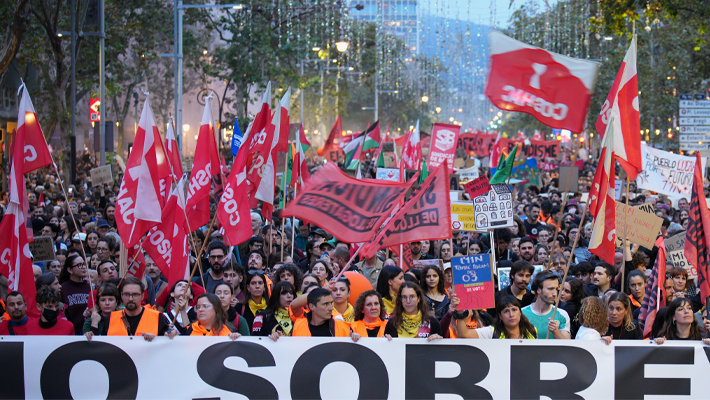
Spanish workers on strike over house rent hikes
According to the country’s central bank data, Spain has a deficit of about 750,000 homes, which is set to grow to over a million by 2028.


