

EU Parliament votes in favour of stricter air pollution limits
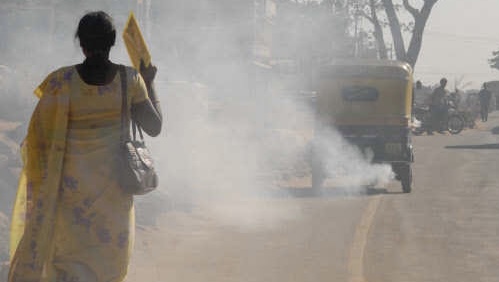
The European Parliament gave the green light on Wednesday for stricter limits on air pollution.
Members of the European Parliament (MEPs) voted in Strasbourg, France, in favour of new upper limits for particulate matter, nitrogen dioxide (NO2), and sulphur dioxide (SO2), among other pollutants.
Representatives of the EU member states and the European Parliament had reached a provisional agreement in February.
The new rules, the parliament said at the time, were intended to ensure that air pollution in Europe does not harm human health.
In future, citizens should be entitled to compensation if they fall ill due to non-compliance with limit values.
The limit values for certain particulate matter and sulphur dioxide are to be halved.
“By updating air quality standards, some of these were established nearly two decades ago, pollution will be halved across the EU. It will pave the way for a healthier, more sustainable future,’’ said Socialist MEP Javi López, who was responsible for the project in parliament.
Following the vote in the plenary session of the European Parliament, the EU member states still have to confirm the new rules.
This is usually a formality and is scheduled for next week.
According to the European Environment Agency (EEA), poor air quality remains the greatest health risk from environmental conditions.
According to the latest figures, some 253,000 deaths in the EU in 2021 were related to particulate matter levels above the recommended limits of the World Health Organisation (WHO).
The German Association of Cities is calling for polluters to be held more accountable.
They support the goal of reducing pollutants in the air, managing director Helmut Dedy said.
“However, this will only succeed if pollutants are also stopped directly at source. Industry, car manufacturers, the energy sector and agriculture are the main contributors to air pollution,’’ Mr Dedy said.
(dpa/NAN)

We have recently deactivated our website's comment provider in favour of other channels of distribution and commentary. We encourage you to join the conversation on our stories via our Facebook, Twitter and other social media pages.

More from Peoples Gazette

States
Independence: NBA urges Nigerians to expect better future
The NBA said that ordinary Nigerians should be deriving benefit from the subsidy removal rather than hardship.

Agriculture
FG tasks ECOWAS on leveraging financing strategies for agroecology
The federal government has urged stakeholders in the agriculture and finance sectors in the West Africa region to leverage financing strategies to enhance agroecology practices

Politics
Katsina youths pledge to deliver over 2 million votes to Atiku
“Katsina State is Atiku’s political base because it is his second home.”

Abuja
AUST hosts 5MW solar project as experts chart renewable energy roadmap
Azikiwe Onwualu, the vice-chancellor of AUST, says the institution has been selected to host a five-megawatt solar project on campus.

Heading 1
Amnesty condemns four-year prison sentence for Nigerian journalist Farida Isiak
Amnesty International has condemned the arrest and four-year prison sentence imposed on Farida Isiak, a 23-year-old journalist with Nagarta Radio in Kaduna.

Economy
Multinational bank Barclays to fire 5,000 workers to reduce costs, says AI creating efficiency
Barclays has announced plans to cut 5,000 jobs globally, representing about five per cent of its total workforce. One thousand workers already sacked.

Anti-Corruption
EFCC arraigns lovers over alleged N36 million Moniepoint transfer fraud in Benin
The anti-graft agency, in a statement on Wednesday, said the lovers were arraigned on seven counts of cybercrime, conspiracy, and stealing.

States
Anambra: Police reaffirm commitment to religious, traditional institutions
The police command in Anambra reaffirmed its commitment to sustained engagement with religious leaders, traditional institutions, community leaders and other critical partners.
Health
Non-communicable diseases account for three-quarters of deaths worldwide: WHO
Non-communicable diseases account for three-quarters of deaths worldwide but affect different population groups in different ways, a WHO study showed.


