

How arrogance, lawlessness define Godswill Akpabio’s Senate leadership
![Senate President, Godswill Akpabio [Photo: TopeBrown]](https://gazettengr.com/wp-content/uploads/Senate-President-Godswill-Akpabio.png)
Godswill Obot Akpabio aspired to be president of Nigeria and ended up president all the same but of the Senate. In that capacity, he presides over the National Assembly. That makes him the number three citizen of the country, behind only the president and his vice. It is ordinarily a pretty perch from which a lot can be accomplished, but that also depends on what “a lot” means.
Unlike many politicians in Nigeria, Akpabio went to schools that were in existence at the time he received his certificates, and he has schoolmates who are still alive. He completed high school at the Federal Government College, Port Harcourt, and received his first degree in law from the University of Calabar, where he was also speaker of the students’ union parliament. At the Nigerian Law School in Lagos, he sat two rows behind former Ohanaeze Nd’Igbo president-general Nnia Nwodo and three in front of yours truly. On November 3, 1988, he was admitted to the Nigerian Bar.
Akpabio is one of the very few politicians to have held office continuously in Nigeria through the quarter century since the country returned to civil rule. Coincidentally, the man whom he succeeded as Senate President is another.
Over this period, Akpabio has held a combination of appointive and elective office in the state cabinet as both commissioner and governor; and at the federal level as senator and minister. On his first tour of duty at the Senate, he took control of a small fraction as Minority Leader in 2015 with the Peoples Democratic Party (PDP). Three years later, in 2018, Akpabio flipped parties, crossing over to the All Progressives Congress (APC). Now he carries on as if he owns the whole place.
In 2023, Akpabio’s ambition was the presidential ticket of the ruling party, but, as it turned out, it was not his turn. By the time the presidential ticket was decided, however, the party had also concluded primaries for the other elective positions down-ballot. In his home constituency in Akwa Ibom State, the ticket for the Senate was originally decided in favour of Udom Ekpeudom, a retired deputy inspector-general of police.
Like his predecessor in the office of Senate President and by dint of a brand of judicial invention to which Nigeria uniquely holds the patent, Akpabio successfully edged out the original winner and ended up with a ticket to the Senate from the party.
Emmanuel Aziken delicately reports that “the role of money in the rediscovery of Akpabio and Lawan remains in the realm of speculation and extending that in this commentary may breach upon the integrity of the Supreme Court which validated the candidature of the two men.”
Akpabio’s tenure as Senate President has been busy. He has the dubious distinction of being responsible for the largest cabinet, coinciding also with the harshest times in the country’s history. He led the upper chamber to consent to the appointment of 20 special advisers to the president and successfully screened 49 nominees for ministerial appointment, including at least one serving member of the National Youth Service Corps (NYSC). He also turfed out three ministerial nominees, including the former governor of Kaduna State, Nasir El-Rufai.
Under him, the business of the Senate happens at the speed of Abracadabra.
When Akpabio ran to be Senate President, his campaign manager was Ali Ndume, the senator for Borno South who, coincidentally, grew up in Port Harcourt around the same time that Akpabio did high school there. When the spoils fell to be shared thereafter, Senator Ndume emerged as the Majority Whip.
There was, therefore, a justifiable spectacle to the scene that unfolded on the floor of the Senate around 11 October, when Mohammed Onawo, who represents Nasarawa South, rose to complain that the Senate President was “just passing bills without prior notification, even money bills, you just pass without anyone’s contribution and within two hours.
“This is not good for Nigeria, and history will judge you,” he said. He also said senators generally bridled at the fact that they had been ambushed all the time when very sensitive bills are brought and expected to be passed with the speed of light, which is not good for this country. This complaint ostensibly had the support of the Senate Whip.
This sounds serious. For example, the National Broadcasting Corporation (NBC) has sent to Akpabio an oppressive Social Media Regulation Bill. At his rate of parliamentary business, it could all be passed in less than a day with few or no questions asked.
Anyway, Senate President Akpabio did not bother to controvert Senators Onawo and Ndume. Instead, he took the opportunity to articulate his philosophy of parliamentary business and leadership which is best described as the doctrine of prophetic altruism. In his own words: “If what we pass is good for the country, history will judge me right. If what we are passing with the speed of light is in the interest of Nigerians, history will judge me right. I don’t think we would come here to pass a bill that will not be in the interest of Nigerians.”
Four years ago, while he was still a minister in the federal cabinet, Thisday newspaper reminded us that “Akpabio is not a man of ideas, neither is he one to embrace the niceties of democratic norms because respect for due process and the rule of law – the core values of democracy – are not part of his forte. He’s just a believer in the power of cash, and whatever cash cannot buy, more cash can buy it.”
Akpabio’s philosophy of prophetic altruism embodies three dangerous propositions. First, he sets up a contradiction between parliamentary due process on the one hand and public good on the other, manufactured in his head entirely for the purpose of retrenching the former without any intention of fulfilling the latter.
Second, he transforms “if” from a contingency to a prophecy, essentially granting himself the license to trample whatever he can in pursuit of whatever he fancies in the misbegotten belief that his fancies represent the public interest.
Third, Akpabio goes further in a fit of terminal conceit to clothe his presumption with irrefutability, preening himself as the embodiment of every citizen and transforming him into the parliamentary equivalent of Louis XIV.
This shows a remarkable consistency of hubristic narcissism but will be news to citizens beholding the filigree of new SUVs to all members of the National Assembly funded from the proceeds of unconcealed quantitative easing, while many of them die from an epidemic of penury supervised with glee by Akpabio.
When he governed Akwa Ibom State, Godswill Obot Akpabio liked to describe himself and his tenure as “uncommon.” By the time he arrived at the Senate, he found himself in the company of 108 others. To separate himself from them, he metamorphosed into the “Uncommon Senator”.
In an uncommon act of grace to his predecessors, Akpabio chose instead to promise as he ran to lead the 10th Senate that he would be an “uncommon transformer” if chosen. His rhetoric of running an uncommon Senate has now disintegrated into a reality of uncommon lawlessness.
In the past week, Akpabio boasted about how he ignored the invitation of the Economic and Financial Crimes Commission (EFCC) to answer to serious allegations of financial crime against him because, he claimed, it was based on a “frivolous petition”.
He implied in the same line that former governors were above the law. One citizen summed it all up in two fitting words: “audacious rogues.”
A lawyer and a teacher, Odinkalu can be reached at chidi.odinkalu@tufts.edu

We have recently deactivated our website's comment provider in favour of other channels of distribution and commentary. We encourage you to join the conversation on our stories via our Facebook, Twitter and other social media pages.

More from Peoples Gazette

States
Independence: NBA urges Nigerians to expect better future
The NBA said that ordinary Nigerians should be deriving benefit from the subsidy removal rather than hardship.

Agriculture
FG tasks ECOWAS on leveraging financing strategies for agroecology
The federal government has urged stakeholders in the agriculture and finance sectors in the West Africa region to leverage financing strategies to enhance agroecology practices

Politics
Katsina youths pledge to deliver over 2 million votes to Atiku
“Katsina State is Atiku’s political base because it is his second home.”
Hot news Home top
France deploys 70,000 police officers to curb looting amid nationwide protests
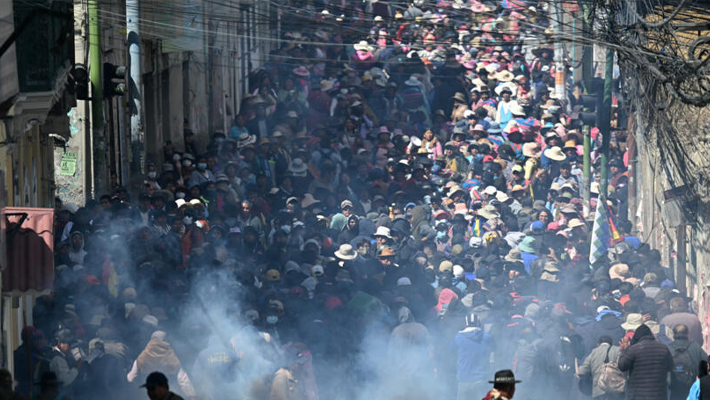
Thousands of youths gathered at Marseille where police fired tear gas to disperse the protesters.

Sport
Nicolas Jackson’s brace for Aston Villa condemns Man City to first league defeat
Nicolas Jackson played under under Enzo Maresca at Chelsea.

Politics
APC mobilisers caution party members against mentioning Tinubu’s name during campaigns in North
The development comes as the APC kick-started its 2027 campaign rallies in Kaduna.
Africa
Ghanaian Samuel Sey detained by ICE after backing Trump’s immigration crackdown
Mr Sey moved to the U.S. in 2022 and got married in Ohio.

World
Canada defends proposed social media ban for under-16s amid free speech concerns
Countries like Australia, Malaysia and Indonesia have implemented similar restrictions.

World
UK police arrest 15-year-old boy for photoshopping local politician into rabbit
The minor was detained for over two months.


