

Jungle justice threat to security, safety in Nigeria, stakeholders warn

Stakeholders have expressed worry over the spate of mob killings, saying it posed threats to national security.
Stakeholders, who spoke in separate interviews on Sunday in Lagos, described the increasing act as “disturbing.”
Mob justice or jungle justice is the act of individuals taking the law into their own hands by meting out punishment to alleged offenders without due process.
It is mostly targeted at those accused of theft, where the alleged criminal is publicly humiliated, tortured, stoned, beaten or lynched.
In the past six weeks, the country has recorded several cases of mob killings.
On October 1, a man identified as Monday was beaten to death in Lagos state over alleged cable theft. The mob used copper wire to tie his neck, strangling him to death.
Also, on October 13, in the Agenebode area of Edo, a mob attacked a police station, burnt to death some suspects accused of terrorising the community, and set ablaze the police barracks, patrol vans and the Divisional Police Station.
A mob killed a suspect on October 14 for allegedly stealing a motorcycle at Dei-Dei in Abuja.
On November 2, a man, Sefilahi Danlami, 19, was lynched over alleged theft at the Panteka Market in the Mpape, Abuja.
On October 18, in the Issele-Uku area of Delta, a mob hijacked two suspected motorcycle thieves from the custody of police and lynched them; the same day, in the Sagamu area of Ogun, a mob killed a man, John Udoh, 22, for allegedly stealing a motorcycle.
An assistant superintendent of police, Augustine Osupayi, 46, was killed on October 19 by a mob in the Agege area of Lagos while trying to rescue a driver accused of hitting a motorcyclist.
The mob, unhappy with his intervention, lynched him.
On November 6, a suspected thief was mobbed to death after allegedly attempting to steal from a church at the Modern Market in Makurdi, Benue.
Similarly, on November 9, a suspected burglar was macheted to death by a mob while attempting to commit a crime at Olu-Obasanjo Road in Port Harcourt.
A legal practitioner, Emmanuel Ajayi, said there was a need to prioritise human life.
“The Nigerian Constitution provides for the right to life, and it is declared that nobody’s life should be taken. Section 315 of the Criminal Code Act says that any person who unlawfully kills another is guilty of an offence called murder,” he said.
He blamed illiteracy, unemployment, poverty, religion, and lack of confidence in the police and judicial system, among others, for the rise.
“People lynched because they think that when suspects are handed over to the police or taken to court, they may buy their freedom and return to society to continue their atrocities.
“But there is no justification for mob action. No amount of loss of trust in the police or judiciary should make people take the law into their own hands. Due process must be followed before somebody can be pronounced guilty. This is necessary because a lot of innocent people have lost their lives to jungle justice,” he said.
Mr Ajayi urged the government to take responsibility for protecting lives and property. He said the government should also reform the police judiciary and create employment.
Police spokesman ACP Olumuyiwa Adejobi decried the rising incidents of mob justice. He cautioned Nigerians against its consequences on criminal justice administration, rule of law and global reputation.
Mr Adejobi, in a statement on October 20 in Abuja, condemned the country’s jungle justice trend, describing it as “a deplorable and savage behaviour.”
He said the act had led to the tragic loss of lives and destruction of property across the country.
He said that the inhuman act was a betrayal of justice and due process, undermining the rule of law, fundamental principles and ideals of human rights and justice.
(NAN)

We have recently deactivated our website's comment provider in favour of other channels of distribution and commentary. We encourage you to join the conversation on our stories via our Facebook, Twitter and other social media pages.

More from Peoples Gazette

Agriculture
FG tasks ECOWAS on leveraging financing strategies for agroecology
The federal government has urged stakeholders in the agriculture and finance sectors in the West Africa region to leverage financing strategies to enhance agroecology practices

Politics
Katsina youths pledge to deliver over 2 million votes to Atiku
“Katsina State is Atiku’s political base because it is his second home.”

Heading 4
Six alleged Nigerian fraudsters targeting UK citizens arrested over online fraud
The suspects, aged between 20 and 34, were arrested in Asaba, Delta State, on July 4.

World
Mother of Henry Nowak’s killer jailed for removing weapon from murder scene
Mr Digwa was sentenced to life imprisonment with a minimum term of 21 years for Mr Nowak’s murder.

Hot news Home top
Two Anambra men to die by hanging for raping teenage girl to death
The prosecution counsel said the victim was rushed to a hospital on police instruction but was confirmed dead on arrival.

Economy
Naira ends week stronger with 0.9% gain against dollar at official market
Data published on Friday by the Central Bank of Nigeria (CBN) showed the local currency gained N1.34 compared with Thursday’s closing rate of N1,381.52 per dollar.
States
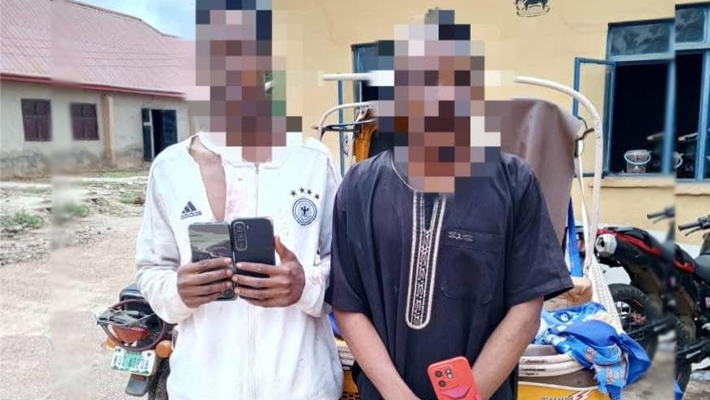
Niger: Police rescue two suspected phone thieves from mob
He identified the suspects as Hassan Abdullahi, 20, and Khalifa Bashir, 22.

Heading 5
Court of Appeal nullifies Electoral Act provisions on parties’ primary election, membership register
Zenith Party argued that the disputed Electoral Act provisions unlawfully interfered with the internal affairs of political parties.


