

Senegal prioritises seed production to boost food sovereignty

Senegal has made the rebuilding of its national seed stock an absolute priority as part of efforts to achieve food sovereignty.
The Minister of Agriculture, Food Sovereignty and Livestock, Cheikhou Oumar Ba, said the initiative is aimed at strengthening agricultural productivity and food security in the country.
Mr Ba said this at the opening of a workshop in Dakar organised to review the Senegalese Institute of Agricultural Research’s 2025 seed production performance and plan its programmes for 2026.
According to the minister, food sovereignty depends largely on the country’s ability to produce, multiply and make available high-quality certified seeds to farmers.
“Food sovereignty largely depends on our collective ability to produce, multiply and make available to farmers high-quality certified seeds that are climate-resilient and high-yielding,” he said.
Mr Ba said the research institute produced 49,797 kilogrammes of pre-basic seeds for several strategic crops during the rainy season and mobilised 102,340 kilogrammes during the hot dry season.
He added that private seed growers also produced 572,438 kilogrammes of groundnut seeds, contributing significantly to the country’s seed development efforts.
“These results are encouraging, but they should not be regarded as an end in themselves,” he said.
The minister said the achievements should serve as benchmarks for measuring progress, identifying gaps and determining the additional efforts required to meet national objectives.
He called for the development of a more integrated, efficient and resilient seed system supported by stronger coordination among research institutions, certification and inspection agencies.
Mr Ba also urged seed producers, professional organisations, private companies and financial partners to strengthen collaboration in advancing the country’s agricultural transformation agenda.
Senegal inaugurated a 10-year national seed self-sufficiency programme in 2025, with implementation expected to continue through 2034 as part of broader efforts to enhance food security and agricultural sustainability.
(Xinhua/NAN)

We have recently deactivated our website's comment provider in favour of other channels of distribution and commentary. We encourage you to join the conversation on our stories via our Facebook, Twitter and other social media pages.

More from Peoples Gazette

States
Independence: NBA urges Nigerians to expect better future
The NBA said that ordinary Nigerians should be deriving benefit from the subsidy removal rather than hardship.

Agriculture
FG tasks ECOWAS on leveraging financing strategies for agroecology
The federal government has urged stakeholders in the agriculture and finance sectors in the West Africa region to leverage financing strategies to enhance agroecology practices

Politics
Katsina youths pledge to deliver over 2 million votes to Atiku
“Katsina State is Atiku’s political base because it is his second home.”

States
Govt requires citizens’ support to meet societal needs, says Makinde
Governor Seyi Makinde says no government can meet all societal needs without support from individuals and corporate organisations.

World
Children, teacher shot dead by teenager at Oregon elementary school
A teenager opened fire at a primary school in Oregon, U.S., killing three children and one teacher on Thursday.
NationWide
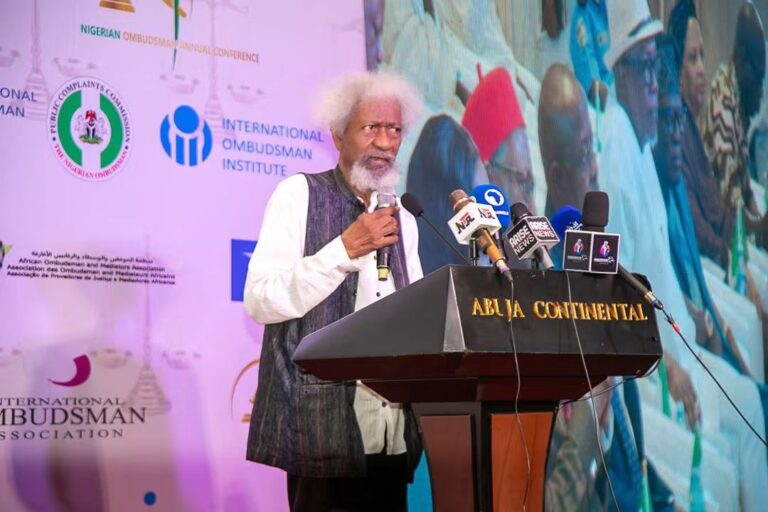
Soyinka urges PCC to prioritise enforcement of court judgements
Nobel Laureate Wole Soyinka has urged the Public Complaints Commission to prioritise enforcement of court judgments to bridge the gap between justice delivery and implementation.

Economy
Energy security critical to digital inclusion, industrialisation, says Oilserv boss
Emeka Okwuosa, chairman of the Oilserv Group, says reliable energy security is critical to digital inclusion and industrialisation in Nigeria.
NationWide
Tinubu has no plan to hike electricity tariffs: Tegbe
Mr Tegbe said this in Ibadan while flagging off the 17.7MW hybrid solar mini-grid project, with a 17.74MW Battery Energy Storage System for communities in Oyo state.

Abuja
Power supply restored to parts of Abuja after 40-hour outage: TCN
The Transmission Company of Nigeria (TCN) says it has restored bulk electricity supply to several areas in Abuja following an outage that lasted more than 40 hours.


