

Singer Blaze: Why Nigeria’s multimillion-naira markets often go up in flames
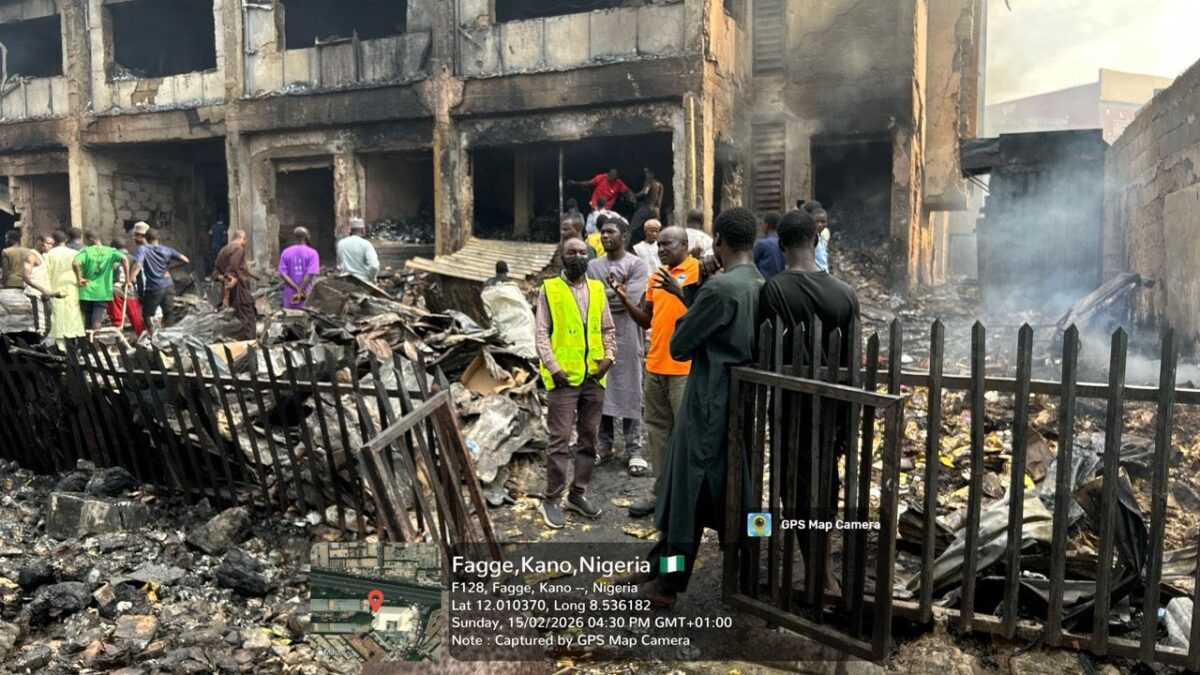
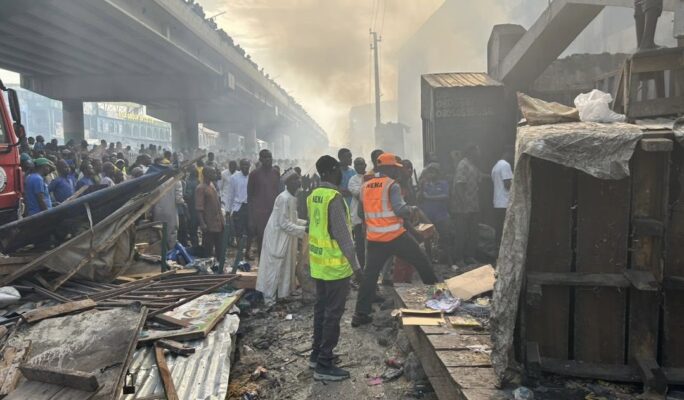
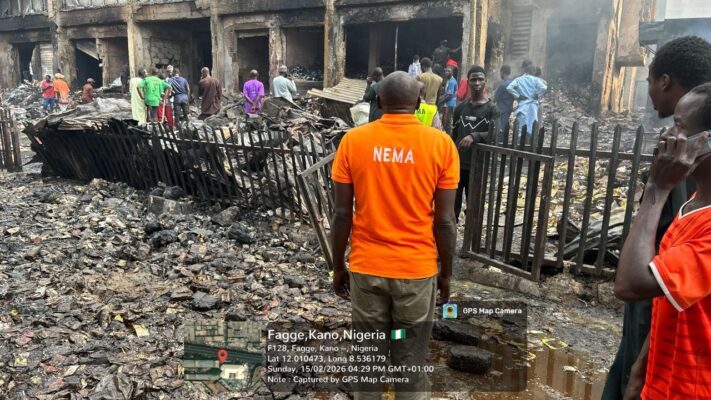
Scores of business owners and traders were thrown into distress and suffered economic losses of over N5 billion after the inferno that ripped through Singer Market in Kano State on February 14, the latest in a pattern of fire disasters in the country’s commercial centres.
Singer market’s chairman, Junaid Zakari, who described the inferno as one of the most severe in the market’s history, said over 1,000 shops were razed and seven people were still unaccounted for two days after, raising renewed concerns about market safety in the state and Nigeria at large.
The market, which derived its name from the popular ‘Singer sewing machine,’ is one of the largest commodity markets in Kano and Northern Nigeria. It supplies a wide range of goods, from groceries and foodstuffs to household items and textiles, to most northern states and even to neighbouring West and Central African countries.
The latest fire outbreak—the second major inferno there in weeks—started in the Gidan Glass section of the market, sweeping rows of densely packed stalls and consuming at least four residential and business buildings.
Meanwhile, President Bola Tinubu had since ordered a full-scale investigation into the repeated fire outbreaks in the market, directing authorities to identify root causes and recommend preventive measures.
As part of its efforts to support victims, the Tinubu-led government announced a N5 billion donation; the All Progressives Congress governors donated N8 billion; and Deputy Senate President Barau Jibrin donated N100 million to the affected traders.
A disturbing trend
The recurring fires raise significant concerns about effective safety infrastructure. According to checks, at least 42 market infernos were recorded nationwide, including Sabon Geri in Kano, Wadata in Benue, Nnewi in Anambra, Leventis in Yobe, Karu in Abuja, and others between 2023 and 2025.
Lagos, Nigeria’s commercial hub, recorded over 17 fires, including the Great Nigeria House at Balogun Market, Lagos Island; the Cairo market in Oshodi; and the Dosunmu market blaze. Hundreds of shops, offices, and restaurants were razed.
On February 15, another fire incident affected parts of Karimo Market in Abuja, with no fatalities recorded, according to a statement by the National Emergency Management Agency (NEMA).
Over 100 lives were lost in fire-related incidents in residential and commercial areas in 2024, accounting for a significant share of the estimated N67.1 billion in losses, according to an annual report by the Federal Fire Service.
Statistics released by the service for 2025 showed a more devastating loss from fire outbreaks nationwide, amounting to an estimated N74.75 billion. Market infernos alone accounted for N22.27 billion of losses.
“Markets and trading centres recorded 190 fires; vehicles/automobiles—177 fires; while other types of premises were 105,” the report said.
Why Nigerian traders burn their cash
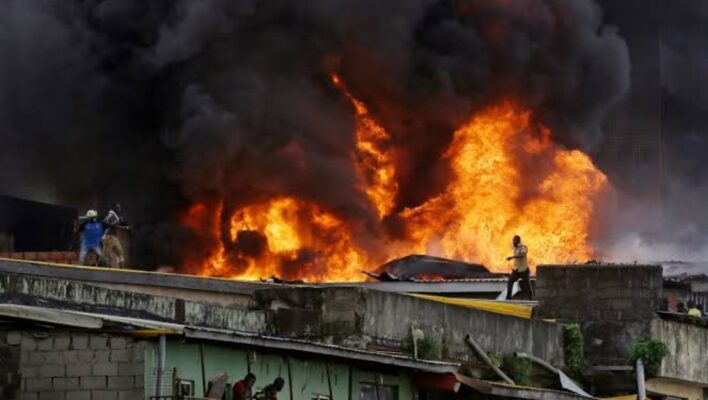
Investigations and post-incident assessments by several state fire agencies revealed that most market infernos are not accidental and are largely preventable.
A major contributor is the electrical fault resulting from power surges, including overloaded sockets, substandard wiring, illegal connections and the routine practice of leaving appliances plugged in overnight.
According to the federal fire agency’s 2025 statistics, electrical faults accounted for nearly 70 per cent of all fire outbreaks nationwide. The agency said deaths from market blazes were responsible for over a third of all fire-related fatalities recorded in the same year.
“Deaths from markets inferno were responsible for over a third of all fatalities, likely due to high occupancy and rapid fire spread in crowded trading environments,” the report stated.
The federal fire service also found that traders often sleep in their shops, relying on candles or improvised lighting, a practice that increases the risk of nighttime ignition, reflecting weak compliance with basic fire prevention protocols.
During its assessment of the Singer Market inferno, the fire service stressed the need for sustained public awareness on the use of fire safety equipment, particularly fire extinguishers, in homes, markets and business premises.
A recent report by the Lagos State Fire Service attributed up to 80 per cent of market fire incidents to carelessness, resulting from improper use of appliances, leaving combustible materials near heat sources.
Reports published by fire agencies in Kwara, Lagos and Kano between 2023 and 2025 linked structural and planning deficiencies within markets to frequent fire outbreaks. The findings showed several markets had expanded swiftly over the years without approved extensions and makeshift stalls, which block lanes purposely designed for evacuation when fire breaks out, slowing containment efforts.
Similarly, regulatory and enforcement failures amplify fire risks in marketplaces, with many markets operating freely without mandatory fire prevention tools and trained safety marshals.
Despite the high temperatures and low humidity, which accelerate combustion during the dry season, fire authorities revealed that traders store inflammable materials such as petrol and other substances in markets, increasing the risk of ignition. A 2023 report by the Anambra fire agency specifically indicated discarded cigarette stubs and nearby bush-burning—especially in peri-urban markets—as environmental factors in market infernos.
Traders’ calls for reforms
Concerns persist about whether the government and market authorities have the necessary mechanisms to prevent fire outbreaks.
Last year, the fire service’s former controller-general, Abdulganiyu Jaji, commended Mr Tinubu for approving the procurement of state-of-the-art firefighting appliances and remodelling of the national fire academy to enhance the agency’s overall performance.
Mr Jaji said the service would also focus on raising awareness and improving response times through cutting-edge technologies such as the National Fire Detection and Alarm System (NAFDAS) and a fire alarm app known as N-Alert.
However, the incident at the Singer market highlighted deep-rooted structural, safety, and regulatory failures that have continued to take a heavy toll on traders.
Traders who spoke to Peoples Gazette about the incident attributed it to poor solar installation, congestion during trading, and the closing process.
“Congestion during trading and closing hours reveals a disturbing issue that might trigger a fire outbreak,” said a trader, Sani Aliyu. “While other factors, such as poor electric and solar installations, have also been identified for incidents like this, it will be helpful if the government can decongest the market to give more space for monitoring of activities.”
Aliyu Hassan, another trader, who said the market is densely populated with kiosks and residential buildings, decried the lack of firefighting equipment to contain such incidents.
“The fire started at one shop in Gidan Glass,” Mr Hassan said. After some hours, the inferno spread across all the shops at Gidan Glass, where properties worth billions were destroyed. Some said the fire was caused by a faulty solar system; no one is sure yet. But the lack of facilities in the market made it easier for the fire to spread very quickly, despite emergency efforts.”
Abubakar Isa, a textile dealer who lost goods worth N250 million in the inferno, also identified uncontrolled congestion as a contributing factor. He said the infrastructure deficit further worsened the situation.
While stating that efforts to relocate some market sections were resisted by some traders in the past, Mr Abubakar decried the lack of strict mechanisms that should have prevented such a tragedy.
“I lost everything I had,” the trader said. “It is wrong that despite a previous fire outbreak in the market some months ago, no infrastructural facilities were put in place to prevent recurrence. We heard that some sections would be relocated elsewhere, but nothing has been done yet.”
Meanwhile, Interior Minister Olubunmi Tunji-Ojo called for the urgent reform of Nigeria’s fire service law, describing the existing legislation as outdated and inadequate for modern rescue operations.
“The National Assembly is already working on the fire service law because the Fire Service Act that we have at the moment is over 60 years old. We need to, of course, improve the rescue operations,” stated Mr Tunji-Ojo at the decoration of the new comptroller-general of the fire service, Olumode Samuel-Adeyemi, in Abuja last year.
On February 17, Mr Samuel-Adeyemi said the federal government had concluded plans to establish fire stations in senatorial districts nationwide to mitigate fire disasters. During an on-the-spot assessment of the Singer market, he said a fire post would be established there to curb recurring outbreaks.
He identified faulty electrical wiring, unsafe fuel storage, cooking inside shops, use of generators, lithium battery installations, and unattended electrical appliances as major causes of market fires.
To mitigate market fire outbreaks, NEMA suggested safety tips, such as installing smoke detectors and fire extinguishers, engaging professionals for solar installation and maintenance, and avoiding overloading sockets.
Experts weigh in
Amina Abdul, a disaster management expert and senior lecturer at the Federal College of Education, Katsina, reiterated the need for fire-resistant structures, especially in marketplaces.
Mrs Abdul cited storage of flammable materials, carelessness among traders, and arson, among others, as triggers of fire incidents in commercial centres.
“Fire in marketplaces can be prevented by having working fire service stations close to markets, accessible roads to fire incident markets, reporting incidents of fire outbreaks early enough, and teaching the rudiments and prevention of fire outbreaks in marketplaces,” said Mrs Abdul.
She also called for adequate firefighting equipment and mandatory programmes for firefighters to achieve maximum effectiveness.
For his part, a sustainable development expert, Basheer Luqman, attributed recurring incidents to human, technical, and environmental factors, including electrical malfunctions traced to overloaded circuits, illegal tapping or bypasses, and power surges.
Mr Luqman emphasised the need for governments at all levels to deploy preventive measures to tackle the trend.
“Preventing these tragedies requires moving from a reactionary culture to a preventive one. Modernising electrical systems by transitioning from surface wiring to conduit wiring and ensuring every shop has its own functional circuit breaker. Zoning and decongestion of high-risk goods (flammable chemicals/fuels) should be separated from general goods.
“There must also be clear, strictly enforced ‘fire lanes’ for emergency vehicles. Meanwhile, on-site fire response in the markets should have functional fire hydrants, water tanks, and trained ‘Market Fire Marshals’ (recruited from the traders) who can act in the first five minutes of an outbreak.
“Likewise, mandatory fire extinguishers at every shop must be required to have a serviced fire extinguisher as a condition for opening,” Mr Luqman stated.
While noting that the government “cannot just be a sympathiser who visits after the damage is done,” the expert urged agencies to conduct quarterly fire safety audits, ban hazardous activities in marketplaces, invest heavily in infrastructure, and incentivise insurance.
“Our markets are growing in economic value, but our safety standards are stuck in the past. We are trying to run 21st-century commerce with 19th-century safety infrastructure. We must treat fire safety as a non-negotiable cost of doing business, rather than an optional luxury,” Mr Luqman reiterated.

We have recently deactivated our website's comment provider in favour of other channels of distribution and commentary. We encourage you to join the conversation on our stories via our Facebook, Twitter and other social media pages.

More from Peoples Gazette

Agriculture
FG tasks ECOWAS on leveraging financing strategies for agroecology
The federal government has urged stakeholders in the agriculture and finance sectors in the West Africa region to leverage financing strategies to enhance agroecology practices

Politics
Katsina youths pledge to deliver over 2 million votes to Atiku
“Katsina State is Atiku’s political base because it is his second home.”

States
Mutfwang hails Tinubu for approving dualisation of Plateau-Taraba road
Mr Mutfwang particularly thanked Mr Yilwatda for his strategic engagement and commitment to the development of Plateau State at all times.

NationWide
Obi thanks God @65, donates ₦10 million to rural hospital in Anambra community
Mr Obi expressed gratitude to God and renewed commitment to the service of humanity.

States
Firearm, phone recovered as police nab four suspected kidnappers in Anambra
The command urged members of the public to remain vigilant.

Heading 3
Spain lift 2026 World Cup after beating Messi’s Argentina
The defeat meant that Lionel Messi and his Argentine teammates failed to become the first team to win back-to-back World Cup titles in 64 years.

States
Fire service rescues man trapped under collapsed Kano wall
The PRO said that the victim was rescued alive and conveyed to the Murtala Muhammed Specialist Hospital, Kano State.

Heading 1
Alake of Egbaland endorses PDP candidate Adebutu for 2027 Ogun governorship race
Mr Adebutu accused successive administrations of denying local governments the financial independence needed to drive development.


