

Stanford University president forced to resign over research frauds

The president of Stanford University, Marc Tessier-Lavigne, announced that he would resign at the end of August after an independent probe of his scientific papers that spanned months found substantial flaws in studies he supervised going back decades.
The probe panel was constituted of outside independent scientists who concluded that Mr Tessier-Lavigne’s works had “multiple problems” and “fell below customary standards of scientific rigour and process,” especially for such a potentially important paper, New York Times reported.
Although the scientist’s professionalism has been publicly questioned on Pubpeer, an online crowdsourcing network for publishing and discussing scientific work, the investigation started after a series of publications by the university’s student newspaper, Stanford Daily which cast doubt on several works produced in laboratories overseen by Mr Tessier-Lavigne.
Last November, the newspaper reported that images were manipulated in published scientific papers with Mr Tessier-Lavigne as either lead author or co-author.
The 89-page report from the Stanford panel was based on more than 50 interviews and a review of more than 50,000 documents. It concluded that Mr Tessier-Lavigne’s employees engaged in improper data manipulation or poor scientific practices, leading to significant flaws in five papers on which he was listed as the primary author.
The panel concluded that the scientist failed to take adequate action to fix errors in a number of cases and questioned why he did not request a correction for the 2009 study after further research indicated that its main conclusion was incorrect.
Additional allegations of fraud about the 2009 study, which Mr Tessier-Lavigne produced while he was a senior scientist at Genentech (a biotechnology corporation), were made public by The Stanford Daily in February. It claimed that a Genentech probe discovered that the study used fabricated data and that Mr Tessier-Lavigne made an effort to conceal its conclusions.
It also added that Genentech had apprehended a postdoctoral researcher who had worked on the study, fabricating data. The assertions, which largely depended on unnamed sources, were categorically rejected by Mr Tessier-Lavigne and the former researcher, now a medical professional working in Florida.
The newspaper articles’ most serious claim was that the scientist covered up malpractices which included falsification of data in a 2009 Alzheimer’s study, but the panel ruled against the assertion, concluding that it was “mistaken” on the basis of lack of proof.
Following the review, Mr Tessier-Lavigne will ask that the 2009 paper, published in Nature and another Nature study, undergo important modifications. He also stated that he would ask for the retraction of three papers: one in 1999 published in the journal Cell; two in 2001 that appeared in Science.

We have recently deactivated our website's comment provider in favour of other channels of distribution and commentary. We encourage you to join the conversation on our stories via our Facebook, Twitter and other social media pages.

More from Peoples Gazette

States
Independence: NBA urges Nigerians to expect better future
The NBA said that ordinary Nigerians should be deriving benefit from the subsidy removal rather than hardship.

Agriculture
FG tasks ECOWAS on leveraging financing strategies for agroecology
The federal government has urged stakeholders in the agriculture and finance sectors in the West Africa region to leverage financing strategies to enhance agroecology practices

Politics
Katsina youths pledge to deliver over 2 million votes to Atiku
“Katsina State is Atiku’s political base because it is his second home.”

Abuja
Abuja: Disability community pledges 500 votes for Tinubu, begs for clinic
Ms Haruna said that despite the challenges facing community residents, they would offer their full support for Mr Tinubu’s re-election bid.

Ibadan
At least one killed in attack on Accord supporters in Ibadan
The police confirmed the death of a man, following Wednesday’s attack on supporters of the Accord governorship candidate, Oriyomi Hamzat, in Ibadan.
States
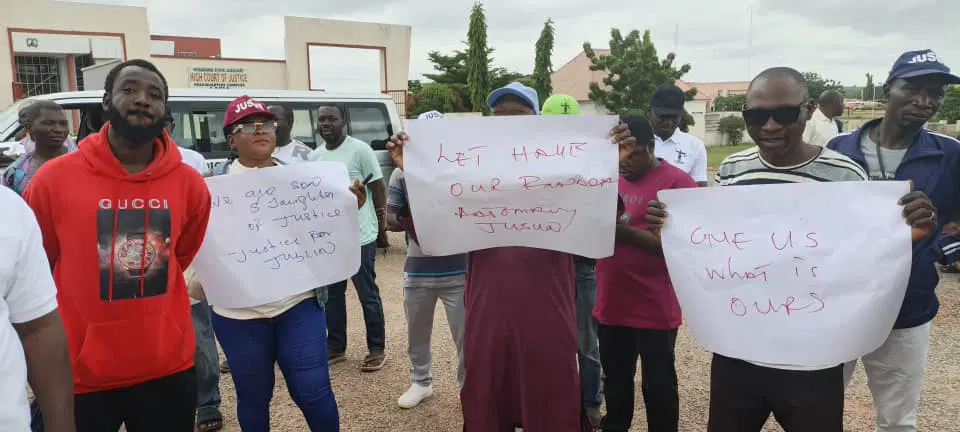
Nasarawa: JUSUN suspends indefinite strike for two weeks
The Nasarawa chapter of the Judiciary Staff Union of Nigeria (JUSUN) has suspended its indefinite strike for two weeks.

States
Kebbi: 19 Nigerian, Chinese nationals convicted of terrorism, illegal arms possession, police say
The Kebbi police command says it has secured the conviction of 19 persons for terrorism, illegal possession of firearms and vandalism of critical national infrastructure.

States
Police, ACJMC join ranks to fight abuse
The Zone 5 police command urged victims of gender-based violence to speak out when abused to get early help from concerned authorities.

Sport
Governor’s Cup: Pankshin FC defeat Jos South FC to book semi-final slot
Pankshin Football Club defeated Jos South FC 1-0 on Wednesday to qualify for the semi-final of the ongoing Plateau State Governor’s Cup.


