

WHO backs twice-yearly HIV injection for immediate global use

The World Health Organisation has called for the immediate global rollout of a breakthrough HIV drug, lenacapavir, that only requires two injections per year to offer near-total protection against HIV and the development of AIDS.
Described as a long-acting antiretroviral alternative to daily pills, lenacapavir was hailed by WHO director general Tedros Ghebreyesus as “the next best thing” in HIV prevention, given the absence of an effective vaccine.
“Lenacapavir has been shown in trials to prevent almost all HIV infections among at-risk populations,” he said in a statement on Monday during the 13th International AIDS Society (IAS 2025) Conference on HIV Science, in Kigali, Rwanda.
WHO emphasised the urgent need to make LEN widely accessible, through pharmacies, clinics, and online consultations, especially as global HIV prevention efforts are faltering.
To increase access, the agency also recommended rapid HIV testing over more complex and costly methods.
According to WHO, 1.3 million people were newly infected with HIV in 2024, with the most affected groups being sex workers, men who have sex with men, transgender people, people who inject drugs, prison populations, and young people.
While lenacapavir is currently available mainly in clinical trials, the WHO urged governments, donors, and partners to incorporate it into national HIV prevention programmes without delay.
The recommendation aligned with the U.S. Food and Drug Administration’s approval of LEN in June.
Other WHO-endorsed HIV prevention tools include daily oral PrEP, injectable cabotegravir (every two months), and the dapivirine vaginal ring.
The call for urgent action came amid major funding cuts to global HIV/AIDS programmes, including PEPFAR, the leading U.S. initiative launched in 2003.
“We have the tools and the knowledge to end AIDS,” said Meg Doherty, director of WHO’s Global HIV, Hepatitis, and STI Programmes. “What we need now is bold implementation of these recommendations, grounded in equity and powered by communities.”
By the end of 2024, an estimated 40.8 million people were living with HIV worldwide, 65 per cent of them in Africa.
Around 630,000 people died from HIV-related causes that year, while 31.6 million were on antiretroviral treatment, up from 30.3 million in 2023.
(NAN)

We have recently deactivated our website's comment provider in favour of other channels of distribution and commentary. We encourage you to join the conversation on our stories via our Facebook, Twitter and other social media pages.

More from Peoples Gazette

States
Independence: NBA urges Nigerians to expect better future
The NBA said that ordinary Nigerians should be deriving benefit from the subsidy removal rather than hardship.

Agriculture
FG tasks ECOWAS on leveraging financing strategies for agroecology
The federal government has urged stakeholders in the agriculture and finance sectors in the West Africa region to leverage financing strategies to enhance agroecology practices

Politics
Katsina youths pledge to deliver over 2 million votes to Atiku
“Katsina State is Atiku’s political base because it is his second home.”

Sport
2027 AFCON Qualifier: Guinea-Bissau beat Madagascar, extend lead over Nigeria in Group L
Guinea-Bissau now have 10 points, Nigeria seven points, while Madagascar and Tanzania have two points each.
Africa
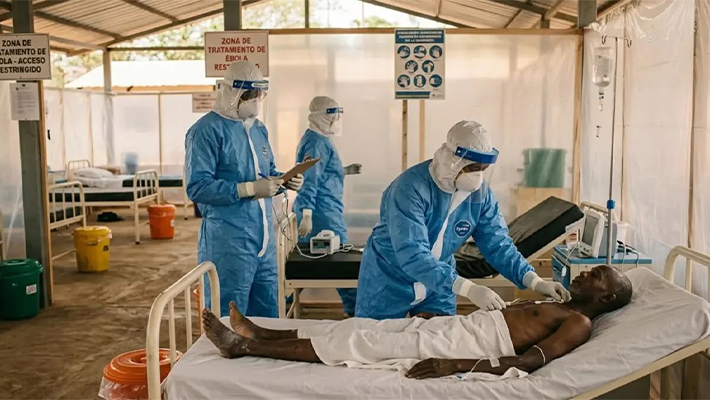
WHO raises concern over rising Bundibugyo Ebola deaths, insecurity in DR Congo
Mr Ghebreyesus said the outbreak, declared six months ago, had spread across 67 health zones in eight provinces in the DR Congo.

Africa
Afreximbank urges industries to boost intra-African trade as alternative to China in global markets
“As global markets look to diversify production beyond China, Africa must position itself as a natural partner of choice,” Mr Maayergi said.

World
Russell Brand faces probe over prison message to supporters
Mr Brand was convicted at Southwark Crown Court of one count of rape and three counts of sexual assault.
Politics
Tinubu admits cost-of-living crisis after APC dismissed widespread hunger claims
According to Mr Tinubu, the 2027 election is about the country’s future and direction.

World
WHO pushes for stronger vaccination, screening, treatment to eliminate cervical cancer
WHO said that expanding HPV vaccination, improving screening access, and ensuring timely treatment are critical to protecting women.


