

WHO official advocates investments in domestic institutions to drive health security
Assistant Director-General, World Health Organisation, Chikwe Ihekweazu, has called for local investments in domestic institutions to drive health security.
He made the call in Abuja on Thursday while delivering a keynote address at the second APIN Public Health Initiatives’ Annual Health Symposium.
The symposium is titled, “Securing our Future: Strengthening Global Health Security in Nigeria.”
Mr Ihekweazu, who oversees the Division of Health Emergency Intelligence and Surveillance Systems at WHO, said that investment in domestic institutions would engender better understanding of health crisis and drive progress.
He added that it would also build capacity to better understand infectious diseases and how they are to be fixed.
He said, “While foreign partners have a role to play, the ultimate responsibility must rest with us and how we are building and empowering our institutions. To do this, countries must put down their own money to act on these challenges and not outsource our problems so completely.”
He also said that the power of institutions was the bedrock of sustainable progress as they held systems together and would be the bridge for a stronger nation.
He stated, “We need to focus on strengthening our institutions, not just for today’s crisis but for tomorrow’s unknowns. Ultimately, our ability to respond to epidemics, to absorb resources and to transform lives depends on the strength of the institution.”
A former Director-General of the Nigeria Centre for Disease Control, Mr Ihekweazu, said that strong institutions were not just about responding to an immediate crisis, but about the ability to absorb development resources.
He further said that it was also about translating aid into action and delivering lasting improvements, adding that weak institutions perpetuate a cycle of dependency.
According to him, global health security depends on local health security, while local health security depends on local institutions.
He noted, “Global health security is ultimately dependent on a network of strong health security institutions acting with similar protocols, mutually dependent on each other.”
The Coordinating Minister of Health and Social Welfare, Muhammad Pate, said that the federal government was working towards a “One Health” approach to ensure that it has unlimited resources to be able to integrate programmes and tackle health issues with effective responses.
Represented by the Director, Port Health Services, Nse Akpan, Mr Pate said this was important to contain and eliminate diseases of importance in the country.
He added that long-term plans were in place to ensure that the elimination and eradication were achieved.
He stated, “So we need to work collectively to ensure that we achieve this. The government cannot do it alone; we need more stakeholders to come up together and see how we can tackle these diseases.”
Mr Pate said that he was glad the country was facing its health challenges head-on, noting a time when development partners might not be able to come to the country’s aid.
Speaking about the symposium, Prosper Okonkwo, the Chief Executive Officer of APIN, Prosper Okonkwo, said that it was aimed at providing a platform for stakeholders to talk about global health security.
He noted that due to climate change, many new diseases have emerged and those that had declined were re-emerging, giving rise to concerns.
“So I think it’s all about trying to bring up issues that can make us better prepared for things that they say it’s not if, but when. So what we are saying is, how can we make our health systems better ready when things happen?
“The example that we had was COVID and for countries where their systems were okay, COVID weakened it and for countries that were already weak, COVID finished it. What we are saying is, can we get our system to a level that can make us ready?” he asked.
APIN, through its symposiums, seeks to influence policies, improve health service delivery and set the stage for the sustained progress of the Nigerian public health landscape in the future.
(NAN)

We have recently deactivated our website's comment provider in favour of other channels of distribution and commentary. We encourage you to join the conversation on our stories via our Facebook, Twitter and other social media pages.

More from Peoples Gazette

Agriculture
FG tasks ECOWAS on leveraging financing strategies for agroecology
The federal government has urged stakeholders in the agriculture and finance sectors in the West Africa region to leverage financing strategies to enhance agroecology practices

Politics
Katsina youths pledge to deliver over 2 million votes to Atiku
“Katsina State is Atiku’s political base because it is his second home.”

States
30 units of 80-inch LG plasma TVs caught with terrorists’ suppliers: Military
A statement by Mohammed Goni, the acting spokesperson for the operation, said the suspects were arrested on Monday at about 1:30 p.m.
States
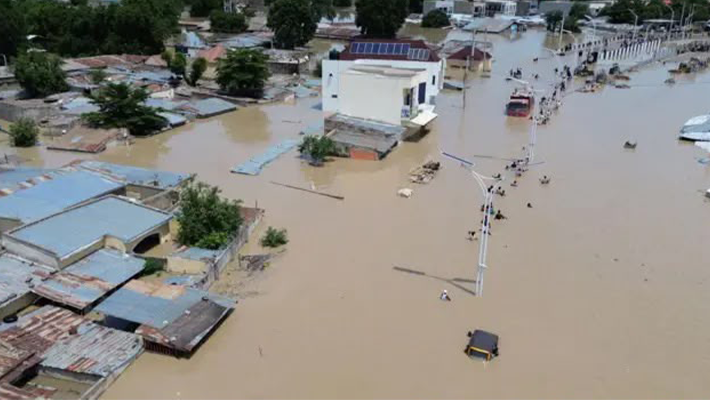
Borno, Adamawa, Yobe map out response strategies, flooding evacuation plans
Borno, Yobe and Adamawa governments have mapped out response strategies and evacuation plans to mitigate the effects of impending floods.

Rights
AUPCTRE faults Tinubu govt over unpaid wage award
The national president of AUPCTRE, Benjamin Anthony, made the call in an interview in Abuja on Wednesday.

Politics
PDP has moved past crisis, uncertainty, says Ohuabunwa
“The party is now rebuilding and will come out stronger and better,” stated Mao Ohuabunwa.

World
U.S. judge orders Trump to release financial records sought by BBC
A court has ordered Mr Trump to produce the financial documents the BBC requested as part of the legal proceedings in his $10 billion defamation suit.

Economy
Navy uncovers nine illegal refineries in Rivers
Five newly excavated pits, prepared for imminent use, were also found and neutralised before they could become operational.


