

Why nuclear weapons remain existential threat to humanity: Expert

A professor of Political Science, Femi Otubanjo, has warned that nuclear weapons have evolved from being mere instruments of warfare to becoming major causes of international conflicts and crises.
Mr Otubanjo, a research professor at the Nigerian Institute of International Affairs, gave the warning while delivering a foreign policy lecture organised by the institute in Lagos on Tuesday.
In the lecture titled, ‘Nuclear Weapons: From Instrumenta Belli to Causae Bellorum’, the professor listed the consequences of nuclear war to include immediate mass casualties, nuclear winter, environmental devastation and psychological trauma.
He added that the consequences would include economic collapse, political disorder and a potential threat to the survival of organised human civilisation.
Mr Otubanjo said that although discussions on nuclear weapons often appeared distant to many Africans, the reality was that such weapons posed an existential threat to all humanity.
According to him, no region of the world would be spared the devastating consequences of a total nuclear war.
He urged greater public awareness and international commitment toward nuclear restraint, warning that humanity could not afford complacency in the face of such a grave threat.
Mr Otubanjo noted that since 1945, nuclear weapons had occupied a unique position in international politics because of their unparalleled capacity for destruction, deterrence and political influence.
“The emergence of nuclear weapons transformed the strategic environment of the 20th Century and continues to shape the international system in the 21st century. Their existence altered the distribution of power, encouraged doctrines of deterrence and generated unprecedented fears regarding the survival of humanity,” he said.
The professor argued that while nuclear deterrence had helped to prevent direct military confrontation among major nuclear powers, controversies surrounding the acquisition, deployment and prevention of nuclear capabilities had increasingly become sources of conventional wars.
He added that the controversies had become sources of diplomatic crises, sanctions and preventive military actions. According to him, nuclear weapons have moved from being mere instruments of war (instrumenta belli) to becoming causes of war (causae bellorum).
Mr Otubanjo cited the longstanding tension between the U.S and Iran as an example of how nuclear issues had become sources of international friction and conflict. According to him, relations between the two countries have remained turbulent since the Iranian Revolution of 1979, with Iran’s nuclear development programme constituting a major point of contention.
Mr Otubanjo noted that disputes over Iran’s nuclear ambitions had triggered diplomatic crises, economic sanctions, international negotiations and recurring security concerns. He said that these demonstrated how nuclear issues had increasingly become causes of conflict rather than mere instruments of warfare.
The professor said that nuclear strategy and international nuclear politics could be understood through deterrence theory, balance-of-power theory, and national-interest theory.
Mr Otubanjo said deterrence theory suggested that states refrained from aggression when the costs outweighed potential gains, adding that the concept became especially influential during the Cold War. This, he said, was due to the “second-strike capability” and the doctrine of Mutual Assured Destruction.
(NAN)

We have recently deactivated our website's comment provider in favour of other channels of distribution and commentary. We encourage you to join the conversation on our stories via our Facebook, Twitter and other social media pages.

More from Peoples Gazette

Agriculture
FG tasks ECOWAS on leveraging financing strategies for agroecology
The federal government has urged stakeholders in the agriculture and finance sectors in the West Africa region to leverage financing strategies to enhance agroecology practices

Politics
Katsina youths pledge to deliver over 2 million votes to Atiku
“Katsina State is Atiku’s political base because it is his second home.”
Politics
Tinubu hails Temitope Ajayi at 50
Mr Tinubu hailed his media aide, Temitope Ajayi, on his 50th birthday, commending him for breaking down key administration policies in in-depth, easy-to-read essays.

Uncategorized
Don’t blame me; Nigerians have been battling poverty, hardship before I became president: Tinubu
“Their circumstances did not begin with the reforms of the last three years,” the president said. “Their struggle is the accumulated consequence of decades of low productivity.”

Anti-Corruption
EFCC arraigns Lagos businessman for fraud
EFCC arraigned businessman Christopher Enyinnwa before Justice Olubunmi Abike-Fadipe of the Lagos Special Offences Court, Ikeja Division, on an alleged N30.14 million fraud.
Faith
Emir of Zazzau pledges support for improved hajj administration efficiency
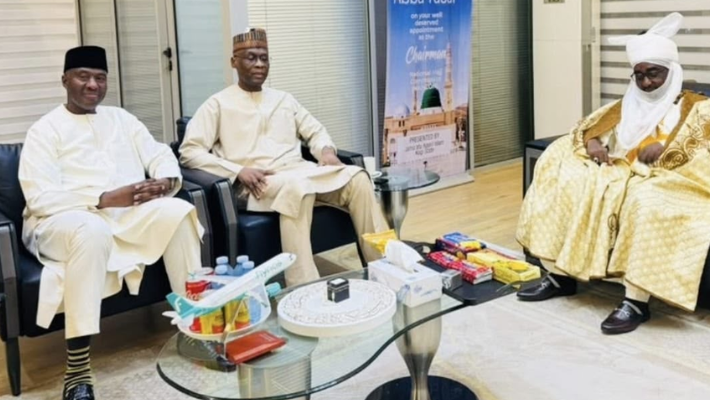
The Emir of Zazzau, Ahmed Bamalli, assured NAHCON of the traditional institution’s support and called for more efficient operations for Nigerian pilgrims.

Economy
CNG, EV interventions reduce transport fares across states, says Pi-CNG
The Presidential Initiative on Compressed Natural Gas and Electric Vehicles (Pi-CNG & EV) says Nigerians are beginning to pay less for transportation.

NationWide
Independence Day: Nigeria slammed for lagging economy
Sa’idu Dattijo Adahama says Nigeria has attained political independence but has yet to achieve the economic independence its founding fathers envisioned.


