

Dangote refinery exports two cargoes of jet fuel to Saudi Aramco in Saudi Arabia

Dangote Petroleum Refinery recently achieved a significant milestone by successfully exporting two jet fuel cargoes to Saudi Aramco, the world’s largest oil producer and a leading integrated oil and gas company globally.
Saudi Aramco is the official Saudi Arabian Oil Company, which is a majority state-owned petroleum and natural gas company that is the national oil company of Saudi Arabia.
President of Dangote Group, Aliko Dangote, revealed this on Tuesday during a visit by the Nigerian Economic Summit Group (NESG) team to both Dangote Fertiliser Limited and the Dangote Petroleum Refinery & Petrochemicals in Ibeju Lekki, Lagos.
Dangote said exporting products to the global markets, especially Saudi Aramco, was because of his refinery’s world-class standards and advanced technologies.
“We are reaching the ambitious goals we set for ourselves, and I’m pleased to announce that we’ve just sold two cargoes of jet fuel to Saudi Aramco,” he said.
Since its production began in 2024, the Dangote refinery has steadily increased its output, now reaching 550,000 barrels per day.
While commending Aliko Dangote for establishing the $20 billion refinery – the largest single-train refinery in the world – NESG Chairman, Mr. Niyi Yusuf, stated that Nigeria needs more investments of this calibre to reach its $1 trillion economy goal.
“To achieve a $1 trillion economy, much of that must come from domestic investments. I joked during the bus ride that while others are dredging to create islands for leisure, you’ve dredged 65 million cubic tonnes of sand to create a future for the country. This refinery, fertiliser plant, petrochemical complex, and supporting infrastructure are monumental,” he said. “My hope is that God grants you the strength, courage, and health to realise your ambitions and that in your lifetime, a new Nigeria will emerge.”
Yusuf emphasised that such local industries are essential to Nigeria’s industrialisation and will help foster the growth of Small and Medium Enterprises (SMEs). He added that the NESG would continue to advocate for an improved investment climate to attract entrepreneurs, boost development, ensure food security, and address insecurity.
He lamented that Nigeria has become a dumping ground for foreign products and stressed that the country must support its entrepreneurs to become a global player. “It’s inconceivable that a nation of over 230 million people, with an annual birth rate higher than the total population of some countries, is still dependent on imports to feed its citizens.”
Yusuf also praised Dangote’s bold vision for making Nigeria self-sufficient in several key sectors.
“The NESG is grateful, and I believe the nation is as well. This refinery represents the audacity of courage. It takes immense effort to do what you’ve done and still be standing and smiling. Thank you for inspiring us and showing that nothing is impossible. You’ve transformed Nigeria from a net importer of petroleum products to a net exporter,” he said. “We’ve all read Think Big, but this is truly about thinking big. The message is clear: the private sector can bring about real change.”
Yusuf, alongside NESG board members and stakeholders, toured the refinery and fertiliser plants, lauding the level of investment, technology, and sophistication of young Nigerian engineers running world-class laboratories and central control units. He acknowledged Dangote’s perseverance and success in overcoming numerous challenges.
Dangote, in his response, reiterated the importance of the private sector in national development, asserting that Nigeria’s challenges could largely be overcome by providing gainful employment to its people.
He stated that the concept of a free market should not be used as a pretext for continued import dependence, highlighting that both developed and developing nations, including the USA and China, actively protect their domestic industries to safeguard jobs and promote self-sufficiency. Dangote also cited the example of the Benin Republic, where cement imports are restricted as part of a deliberate strategy to protect local industries, despite the proximity of his Ibese plant.
“The President is a personal friend, and my Ibese plant is just 28km from Benin, yet they refuse to allow imports to protect their local industries, most of which are grinding plants,” he remarked.
He further emphasised that the government stands to gain substantially when the private sector flourishes, noting that 52 kobo (52%) of every naira Dangote Cement generates goes to the government.
Dangote also pointed out the significant challenges involved in setting up industries in Nigeria, particularly the substantial capital investment required due to the lack of infrastructure. He stressed that investors are often forced to take on responsibilities for essential services such as power, roads, and ports – services that should be provided by the government.

We have recently deactivated our website's comment provider in favour of other channels of distribution and commentary. We encourage you to join the conversation on our stories via our Facebook, Twitter and other social media pages.

More from Peoples Gazette

States
Independence: NBA urges Nigerians to expect better future
The NBA said that ordinary Nigerians should be deriving benefit from the subsidy removal rather than hardship.

Agriculture
FG tasks ECOWAS on leveraging financing strategies for agroecology
The federal government has urged stakeholders in the agriculture and finance sectors in the West Africa region to leverage financing strategies to enhance agroecology practices

Politics
Katsina youths pledge to deliver over 2 million votes to Atiku
“Katsina State is Atiku’s political base because it is his second home.”

States
Police warn youths against blocking Kebbi-Sokoto highway
Mr Usman said the latest blockade disrupted vehicular movement for about three hours.
Africa
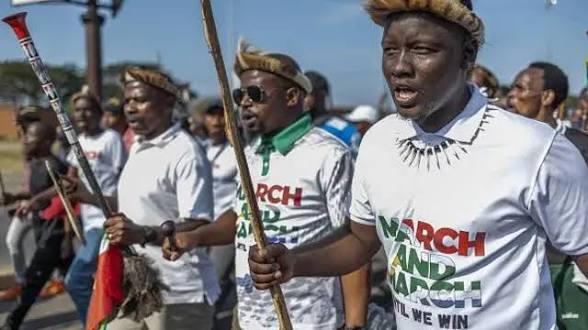
U.S. warns citizens travelling to South Africa over crime, terrorism, unrest
The acting national police commissioner said at least 10 vehicles were burnt in Johannesburg and 14 in Durban.

Economy
Nigeria’s $1 trillion economy depends on homegrown innovation, market access: NBTI DG
The DG said sustainable national prosperity cannot be achieved through government expenditure or natural resources alone.
NationWide
NBET begins N729 billion legacy debt payments to GenCos
Mr Odeyemi described the development as a significant milestone in implementing the debt reduction programme.
Africa
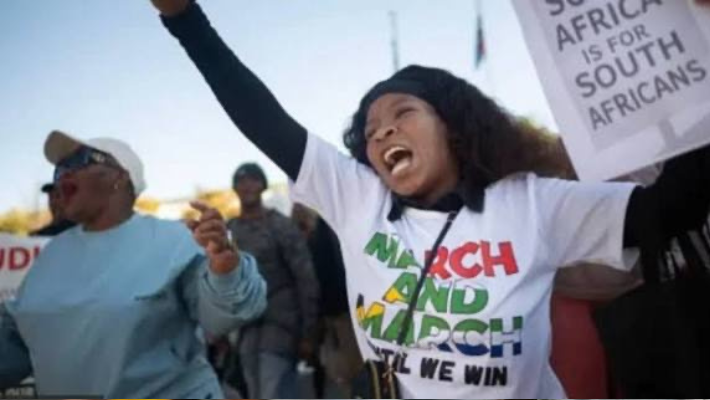
Anti-foreigner protests force South Africa to withdraw asylum seekers applications
The protests erupted over a Constitutional Court ruling easing access to asylum.

Heading 2
2028 Olympics: Super Falcons defeat Comoros 2-0 in first leg
The Nigerian team finally opened the scoring in the 48th minute with a tap-in by Michelle Alozie.


