

Keytruda: Drug breakthrough could benefit breast cancer patients
Treating patients who have a common form of breast cancer with immunotherapy, as well as chemotherapy, before and after surgery could be effective regardless of their age.
This can also happen if they have gone through menopause, according to a study.
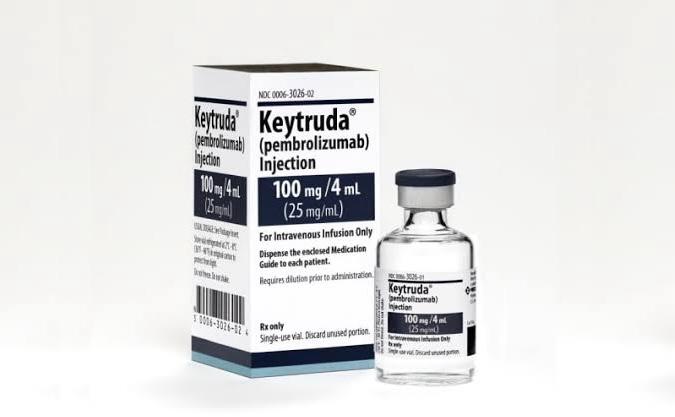
Pembrolizumab, sold under the brand name Keytruda, targets and blocks a specific protein on the surface of certain immune cells, which then seek out and destroy the cancerous cells.
In England, it is offered to those with triple-negative breast cancer, one of the most aggressive forms of the disease, which accounts for about 15 per cent of cases.
However, recent findings from the Keynote-756 trial suggest it could be effective when used more widely.
Researchers explored the use of pembrolizumab on patients with early-stage breast cancer that are at high risk of recurring or spreading further, and that is oestrogen receptor-positive (ER-positive) and HER2 negative.
According to Cancer Research UK, about 80 in 100 breast cancer diagnoses are ER-positive.
Keynote-756 has been running for eight years and comprises 1,278 patients with invasive ductal carcinoma (IDC), meaning cancer had started to spread out of the milk ducts and into the surrounding breast tissues.
Patients were either treated with pembrolizumab and chemotherapy before and after surgery or with a placebo.
Researchers measured the lack of cancer signs in tissue samples, also known as a pathological complete response (PCR) rate.
According to Javier Cortes, director of the International Breast Cancer Centre in Barcelona, Spain, researchers found a “statistically significant increase” in PCR rate among those treated with pembrolizumab.
Some 24.3 per cent of patients had no cancer cells remaining in the breast or lymph nodes compared with 15.6 per cent of patients treated with a placebo.
mR Cortes said, “Now we can show that these PCR rates occurred regardless of the patients’ age or menopausal status.”
The PCR rate in patients younger than 50 was 23.8 per cent, while in those 50 and over it was 24.7 per cent.
The rate was 23.4 per cent in pre-menopausal women and 24.8 per cent in those who had been through menopause.
This is compared with 16.9 per cent, 14.2 per cent, 16.1 per cent and 14.6 per cent, respectively, in the placebo groups.
Pembrolizumab was given the green light for NHS use in patients with triple-negative breast cancer by the National Institute for Health and Care Excellence (Nice) in 2022.
Triple-negative breast cancer accounts for about 15 per cent of all breast cancer cases and a quarter of all breast cancer deaths.
It is more common among younger patients, black women and those with a specific mutation of the BRCA1 gene.
Nice also recommends the therapy for patients with cancers of the bowel, lung and skin, as well as advanced womb cancer and incurable cervical cancer.
“This exciting study shows that adding pembrolizumab to chemotherapy before and after surgery could be more effective in eliminating cancer cells in women with the most common type of breast cancer. It’s also ER-positive HER2-negative, regardless of their age or menopausal status.
“The trial found that pembrolizumab led to more patients having no detectable cancer cells in their breast or lymph nodes when their treatment finished,” said Mr Cortes.
Further research is needed to see whether this translated into improved survival rates and a lower likelihood of cancer returning.
“With over 1,000 people dying from breast cancer every month in the UK, we desperately need new and effective treatments for this disease. Pembrolizumab is currently used for the treatment of triple-negative breast cancer.
“We hope the drug can be submitted to the MHRA for licensing and assessed by Nice as soon as possible so that patients with ER-positive HER2-negative breast cancer may also benefit from this treatment, can access it on the NHS,” he said.
The Keynote-756 trial also found that using pembrolizumab did not hinder the patient’s waiting time for surgery.
“The average time to surgery in both groups of patients was about a month. The average time after surgery to the start of adjuvant treatment was 1.2 months in both groups,” Mr Cortes said.
Tissue collected at the time of the operation was analysed to see if any cancer cells remained after the treatment, known as residual cancer burden (RCB).
This was also lower in patients treated with pembrolizumab.
Some 35 per cent of patients on the treatment had no or very small amounts of cancer cells compared with 23.6 per cent of patients in the placebo group.
A moderate amount was found in 45.3 per cent of placebo patients compared with 40.8 per cent treated with pembrolizumab. An extensive amount was found in 28.9 per cent of the placebo group compared with 20.5 per cent treated with the therapy.
The findings were presented at the European Breast Cancer Conference in Milan.
Conference chairman Michail Ignatiadis of the Institut Jules Bordet in Brussels, Belgium, said, “Follow-up is needed to see whether improvement in PCR rates will result in more patients living for longer without their disease recurring, and we look forward to these data in due course.”
(dpa/NAN)

We have recently deactivated our website's comment provider in favour of other channels of distribution and commentary. We encourage you to join the conversation on our stories via our Facebook, Twitter and other social media pages.

More from Peoples Gazette

States
Independence: NBA urges Nigerians to expect better future
The NBA said that ordinary Nigerians should be deriving benefit from the subsidy removal rather than hardship.

Agriculture
FG tasks ECOWAS on leveraging financing strategies for agroecology
The federal government has urged stakeholders in the agriculture and finance sectors in the West Africa region to leverage financing strategies to enhance agroecology practices

Politics
Katsina youths pledge to deliver over 2 million votes to Atiku
“Katsina State is Atiku’s political base because it is his second home.”

Politics
‘Let’s develop collective agenda,’ Uba Sani advises northern leaders
Governor Uba Sani has said the late Premier of Northern Nigeria, Sir Ahmadu Bello, wanted to build a more united, peaceful and self-sufficient region.

Opinion
How effective is Femi Fani-Kayode’s cowboy diplomacy?
After all, the measure of effective diplomacy is not how much noise a diplomat makes in defending his country, but what his country gains from the noise.

Economy
NGX investors lose N2.9 trillion in two days as stocks decline
Investors on the Nigerian Exchange lost about N2.9 trillion in two trading sessions as sharp declines in major listed companies’ share prices dragged down the market.

States
Police arrest seven suspects for plotting to kidnap Kwara businessman
The police command in Kwara says it has arrested seven suspects over an alleged plot to kidnap a businessman in Bode Saadu.

Economy
Afreximbank launches free training for African creatives
Afreximbank launched a capacity-building programme to equip African creative professionals and entrepreneurs.

Economy
FG, states, LGs share N2.44 trillion as oil, tax revenues decline
FAAC shared N2.441 trillion among the federal, state and local governments as revenue generated in October, amid a decline in oil earnings and major tax receipts.


